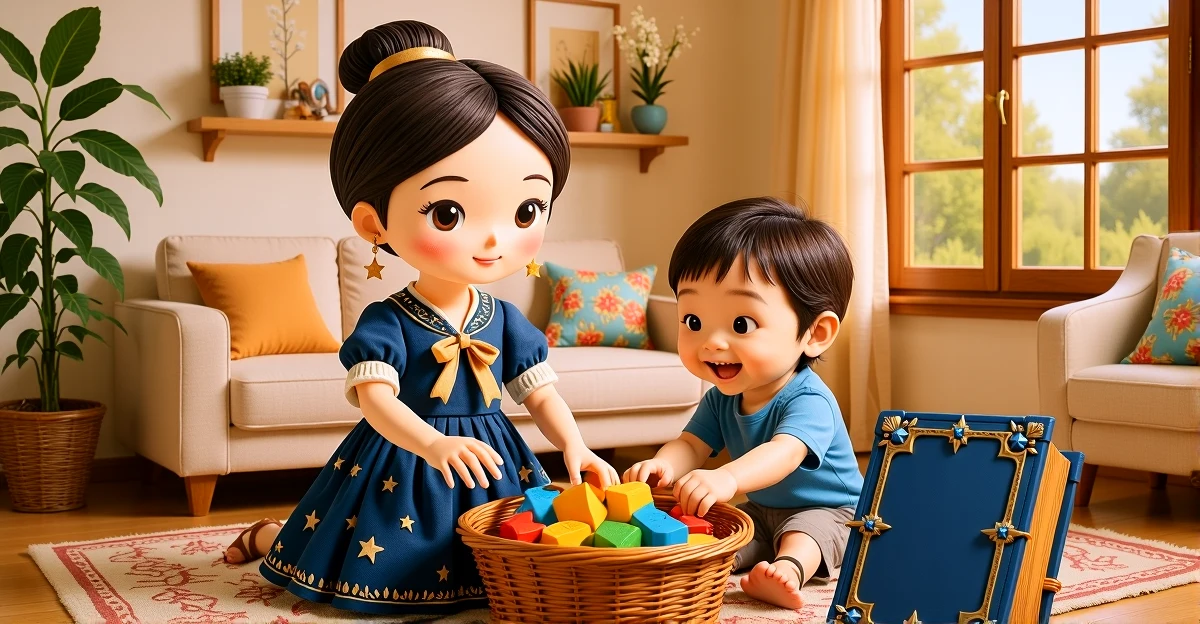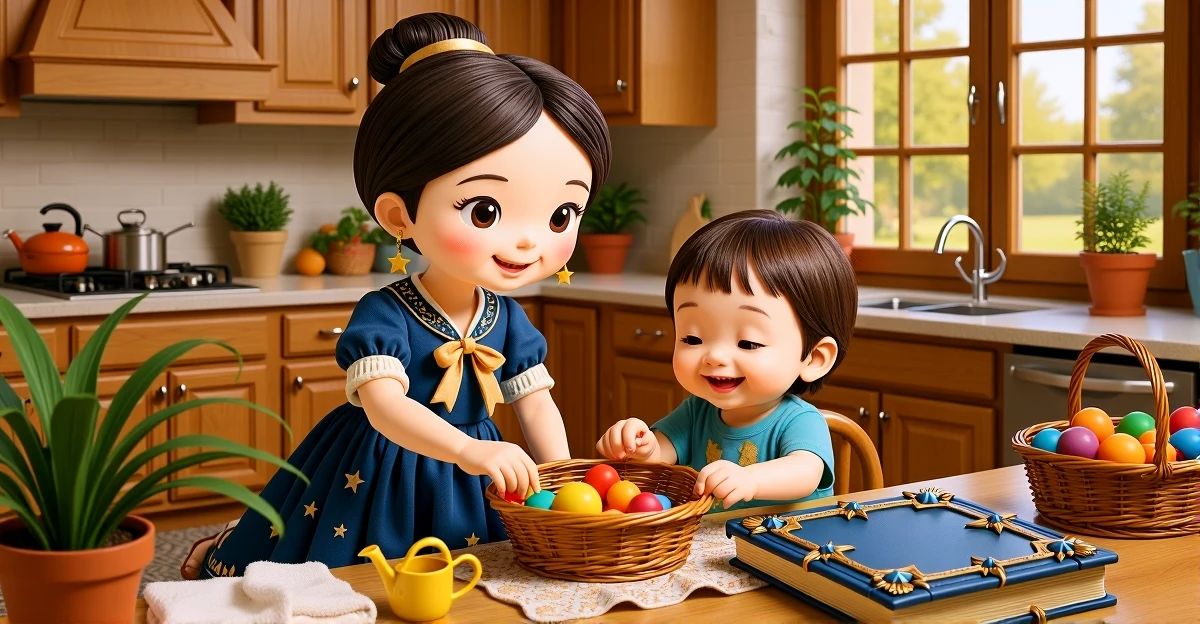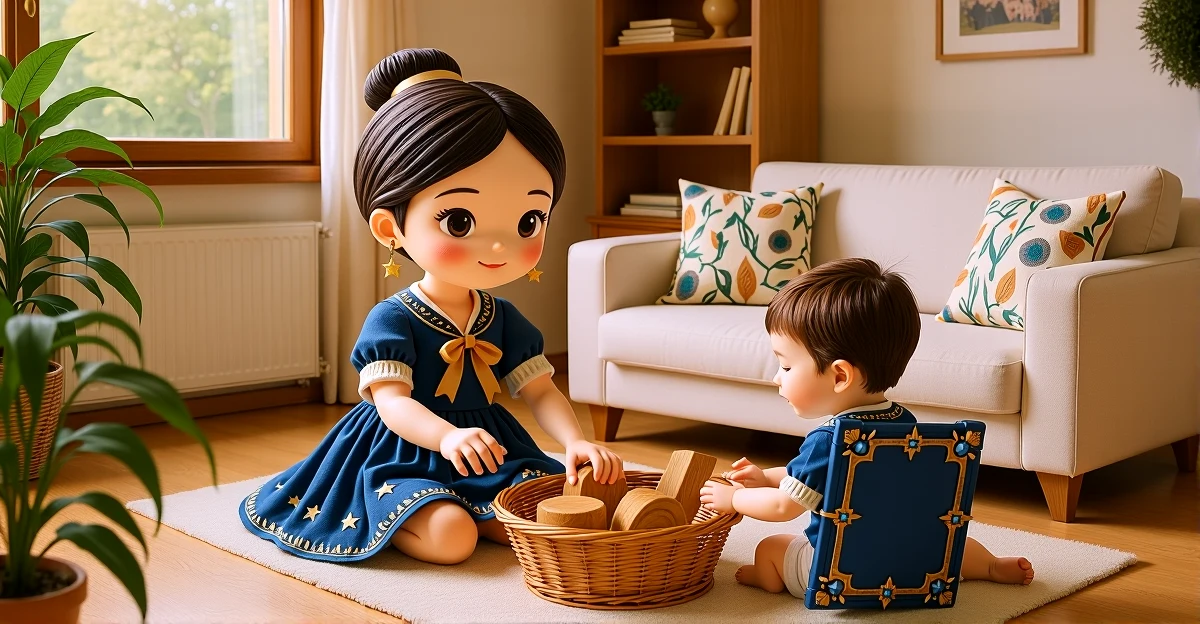
It happens in homes all around the world. Your little one is playing happily with their toys, completely absorbed in their imaginative world. Then it is time to clean up, and suddenly everything changes. Maybe they say no. Maybe they run away. Maybe they just keep playing as if they did not hear you at all. And in that moment, you might feel frustrated, exhausted, or even wonder if you are doing something wrong.
Let me tell you something SO important right from the start. You are not alone in this, and your child is not being difficult. In fact, what is happening is actually quite WONDERFUL when you understand what is really going on.
In this post, we will explore why toddlers resist cleanup, what research tells us about cooperation at this age, and gentle strategies that transform cleanup time from a battle into a joyful learning moment. Plus, I will share a beautiful story from The Book of Inara that teaches gentle care and responsibility in the most magical way.
Understanding Why Toddlers Resist Cleanup
When your toddler, especially between ages two and three, resists helping with cleanup, they are not refusing to cooperate. They are practicing one of the most important skills they will ever learn. They are discovering their independence. They are learning that they are a separate person from you, with their own ideas and their own will. And that, wonderful parent, is exactly what they are supposed to be doing at this age.
Think about it this way. Your little one's brain is growing SO fast right now. They are learning to balance their own wonderful ideas with your guidance. They are discovering that they can make choices. And sometimes, that means they choose to keep playing instead of cleaning up. Not because they are being naughty, but because their developing brain is saying, I have my own ideas about what I want to do right now.
This is actually a sign of healthy development. Your toddler is building the neural pathways for independence, decision-making, and self-regulation. These are crucial life skills that will serve them for years to come.
The Developmental Reality
At ages two and three, children are in a fascinating developmental stage. Their prefrontal cortex, the part of the brain responsible for impulse control and planning, is still in the very early stages of development. It will not be fully mature until they are in their mid-twenties. Right now, they are learning how to manage their impulses, follow multi-step directions, and cooperate with others.
When you ask your toddler to clean up their toys, you are asking them to stop an enjoyable activity, shift their attention, remember where things go, and execute a multi-step task. That is a LOT for a developing brain to handle. No wonder they sometimes resist.
What Research Says About Toddler Cooperation
The American Academy of Child and Adolescent Psychiatry has done beautiful research on children and household tasks. Here is what they found that changes everything.
Children who do chores may exhibit higher self-esteem, be more responsible, and be better equipped to deal with frustration, adversity, and delayed gratification.
— American Academy of Child and Adolescent Psychiatry
But here is the key. For two and three year olds, this is a LEARNING process. Their brains are literally building the neural pathways for cooperation and helpfulness right now. It takes time, patience, and lots of gentle practice.
Research from the National Association for the Education of Young Children demonstrates that children learn cooperation best through warm, trusting relationships with adults who provide gentle coaching, specific praise, and visual cues. They learn by watching us model the behavior, by receiving encouragement when they try, and by practicing over and over again in an atmosphere of love and patience.
Dr. Jeannie Ho and Suzanne Funk, writing in Young Children journal, explain that effective teaching involves coaching on the spot where teachers help children realize what they are doing, understand how their actions affect others, and choose positive alternatives. They emphasize that warmth and affection, even on bad days and when children are misbehaving, are critical to children's well-being.
Zero to Three, a wonderful organization that studies early childhood development, tells us that consistent routines help young children feel secure while they practice social skills. When cleanup happens at the same time each day, with the same gentle approach, your child's brain learns to expect it. The resistance decreases because they know what is coming, and they feel safe in that predictability.
Gentle Strategies That Transform Cleanup Time
So what can we do to make cleanup time feel less like a battle and more like a joyful learning moment? Let me share some WONDERFUL strategies that really work.
1. Make It Small and Manageable
For a two or three year old, the instruction clean up your toys can feel overwhelming. Their little brains cannot yet break that big task into smaller steps. Instead, try saying something specific like, Can you put the blocks in the blue bin? or Let's put the stuffed animals on the shelf together.
Small, clear tasks feel doable, and success builds confidence. When your child successfully puts three blocks in the bin, they experience the satisfaction of completing a task. That positive feeling motivates them to try again.
2. Turn It Into a Game or Song
You know how much young children love music and play? Use that. You might sing a cleanup song, or pretend the toys are going to sleep in their special beds, or race to see how many toys you can put away before a timer goes off.
When cleanup feels playful, cooperation comes naturally. Your child is not being asked to stop playing. They are being invited to play in a different way, one that happens to involve putting toys away.
3. Do It Together
At this age, your child is not yet ready to clean up independently. They need you right there with them, modeling what to do, helping them stay focused, and making it feel like a connection time rather than a chore.
You might say, I will put away the cars while you put away the balls. Let's work together. This teaches them that taking care of our space is something we do as a family, with love. It also gives you precious moments of connection during what could otherwise be a stressful transition.
4. Give Lots of Specific Praise
Instead of just saying good job, describe exactly what you see. You put three books on the shelf. You are taking such good care of your toys. When children hear specific praise, they understand exactly what they did well, and they want to do it again.
This type of praise also helps children develop an internal sense of accomplishment rather than relying on external validation. They learn to feel proud of their efforts and contributions.
5. Create a Consistent Routine
When cleanup happens at the same time each day, perhaps before lunch or before bedtime, your child's brain learns to expect it. You might create a simple ritual. We play, we clean up together, then we have lunch. The predictability reduces resistance because there are no surprises.
You can also use visual cues like a cleanup song that signals it is time to transition, or a visual schedule with pictures showing the sequence of activities.
A Story That Teaches Gentle Care
In The Book of Inara, we have a beautiful story that brings these concepts to life for your child in the most magical way.
The Greenhouse Where Plants Whisper Thank You
Perfect for: Ages 2-3
What makes it special: In this enchanting story, Milo and Nana discover a magical greenhouse where plants glow softly when they are cared for with gentle touches and kind words. The children learn that when we take care of living things with love, they grow stronger and happier. This story teaches gentle care and responsibility without being preachy or instructional.
Key lesson: When we care for things with gentle hands and kind words, we create beauty and connection in the world around us.
How to use it: After reading this story with your child, you can talk about how we take care of our toys and our room just like Milo and Nana take care of the plants. With gentle hands and kind words. You might even create a little ritual where you say goodnight to the toys as you help them rest in their special places. When cleanup becomes a caring ritual instead of a chore, everything shifts.
You Are Doing Beautifully
Here is something I want you to remember on the hard days. Your child is not refusing to cooperate because they do not love you or because you are doing something wrong. They are learning. They are growing. They are building the skills they need to become responsible, helpful, caring people. And that takes time. YEARS, actually.
So on the days when cleanup feels impossible, take a deep breath, remember that this is temporary, and know that every gentle interaction is teaching your child something valuable. You are not just teaching them to put toys away. You are teaching them cooperation, responsibility, and the beautiful truth that we take care of the things and spaces we love.
You are doing such important work, wonderful parent. You are raising a human being, and that is the most BEAUTIFUL and challenging thing anyone can do. The Magic Book and I see you. We see your patience, your love, your dedication. And we want you to know that you are doing beautifully.
So tonight, or tomorrow, when it is cleanup time, try one of these strategies. Make it small, make it playful, do it together, and praise specifically. And maybe read The Greenhouse Where Plants Whisper Thank You with your little one. Let the story plant seeds of gentle care and responsibility in their heart.
With love and starlight, Inara
Related Articles
Show transcript
Hello, wonderful parent! It's me, Inara, and I am SO happy you're here today. You know, the Magic Book and I have been hearing from so many parents lately about something that happens in homes all around the world. Your little one is playing happily with their toys, and then it's time to clean up, and suddenly... resistance. Maybe they say no, maybe they run away, maybe they just keep playing as if they didn't hear you at all. And I want you to know something really important right from the start. You are not alone in this, and your child is not being difficult. In fact, what's happening is actually quite WONDERFUL when you understand what's really going on.
Let me share something the Magic Book taught me that changed everything. When your toddler, especially between ages two and three, resists helping with cleanup, they are not refusing to cooperate. They are practicing one of the most important skills they will ever learn. They are discovering their independence. They are learning that they are a separate person from you, with their own ideas and their own will. And that, my friend, is exactly what they are supposed to be doing at this age.
The American Academy of Child and Adolescent Psychiatry has done beautiful research on this, and here's what they found. Children who participate in age-appropriate tasks like putting toys away develop higher self-esteem, learn to handle frustration better, and build skills that help them succeed in school, friendships, and life. But here's the key. For two and three year olds, this is a LEARNING process. Their brains are literally building the neural pathways for cooperation and helpfulness right now. It takes time, patience, and lots of gentle practice.
Think about it this way. Your little one's brain is growing so fast right now. They are learning to balance their own wonderful ideas with your guidance. They are discovering that they can make choices. And sometimes, that means they choose to keep playing instead of cleaning up. Not because they are being naughty, but because their developing brain is saying, I have my own ideas about what I want to do right now! That's actually a sign of healthy development.
Now, I know this can feel frustrating. You have places to be, meals to prepare, and a home to manage. And when your toddler refuses to help, it can feel like they are making your life harder on purpose. But here's what research from the National Association for the Education of Young Children tells us. Children learn cooperation best through warm, trusting relationships with adults who provide gentle coaching, specific praise, and visual cues. They learn by watching us model the behavior, by receiving encouragement when they try, and by practicing over and over again in an atmosphere of love and patience.
So what can we do to make cleanup time feel less like a battle and more like a joyful learning moment? Let me share some WONDERFUL strategies that really work.
First, make it small and manageable. For a two or three year old, the instruction clean up your toys can feel overwhelming. Their little brains can't yet break that big task into smaller steps. Instead, try saying something specific like, Can you put the blocks in the blue bin? or Let's put the stuffed animals on the shelf together. Small, clear tasks feel doable, and success builds confidence.
Second, turn it into a game or a song. You know how much young children love music and play? Use that! You might sing a cleanup song, or pretend the toys are going to sleep in their special beds, or race to see how many toys you can put away before a timer goes off. When cleanup feels playful, cooperation comes naturally.
Third, do it together. At this age, your child is not yet ready to clean up independently. They need you right there with them, modeling what to do, helping them stay focused, and making it feel like a connection time rather than a chore. You might say, I'll put away the cars while you put away the balls. Let's work together! This teaches them that taking care of our space is something we do as a family, with love.
Fourth, give lots of specific praise. Instead of just saying good job, describe exactly what you see. You put three books on the shelf! You're taking such good care of your toys! When children hear specific praise, they understand exactly what they did well, and they want to do it again.
And here's something else the Magic Book showed me. Children learn responsibility best when they see it modeled with gentleness and care. There's a beautiful story in The Book of Inara called The Greenhouse Where Plants Whisper Thank You. In this story, Milo and Nana discover a magical greenhouse where plants glow softly when they are cared for with gentle touches and kind words. The children learn that when we take care of living things with love, they grow stronger and happier.
This story is PERFECT for teaching the concept of gentle care and responsibility. After you read it with your child, you can talk about how we take care of our toys and our room just like Milo and Nana take care of the plants. With gentle hands and kind words. You might even create a little ritual where you say goodnight to the toys as you help them rest in their special places. When cleanup becomes a caring ritual instead of a chore, everything shifts.
The research is so clear on this. Zero to Three, a wonderful organization that studies early childhood development, tells us that consistent routines help young children feel secure while they practice social skills. When cleanup happens at the same time each day, with the same gentle approach, your child's brain learns to expect it. The resistance decreases because they know what's coming, and they feel safe in that predictability.
And here's something I want you to remember on the hard days. Your child is not refusing to cooperate because they don't love you or because you're doing something wrong. They are learning. They are growing. They are building the skills they need to become responsible, helpful, caring people. And that takes time. YEARS, actually. So on the days when cleanup feels impossible, take a deep breath, remember that this is temporary, and know that every gentle interaction is teaching your child something valuable.
You are doing such important work, my friend. You are raising a human being, and that is the most BEAUTIFUL and challenging thing anyone can do. The Magic Book and I see you. We see your patience, your love, your dedication. And we want you to know that you are doing beautifully.
So tonight, or tomorrow, when it's cleanup time, try one of these strategies. Make it small, make it playful, do it together, and praise specifically. And maybe read The Greenhouse Where Plants Whisper Thank You with your little one. Let the story plant seeds of gentle care and responsibility in their heart.
You've got this, wonderful parent. With love and starlight, Inara.