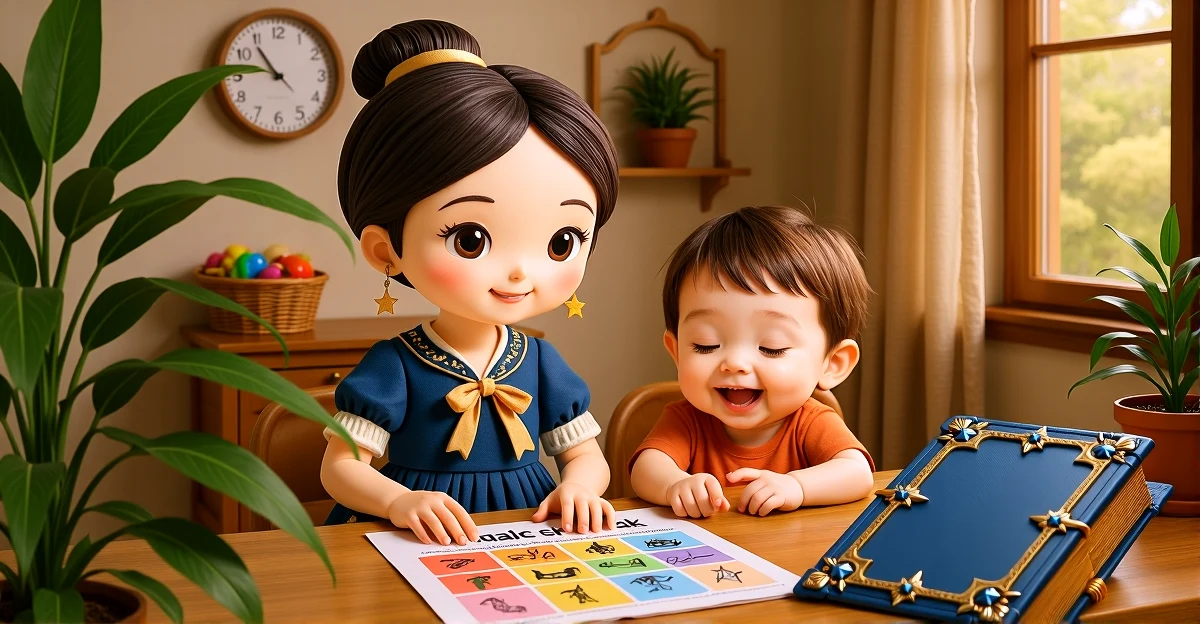

When, when, when. If you have a three or four year old, you've probably heard this question approximately seven hundred times today. When are we going? When will it be snack time? When can I play outside? When is Grandma coming? And you're standing there, trying to explain the concept of "after lunch" to someone who can't read a clock and for whom time is still a beautifully abstract mystery.
First, let me tell you something WONDERFUL: You're not alone, and your child's constant questions about when are actually a beautiful sign that their brain is growing and developing exactly as it should! The Magic Book showed me that this is one of the most exciting phases of early childhood development, and there are gentle, practical ways to help your little one understand time without needing to teach them to read a clock.
In this post, we're going to explore how young children understand time, what research tells us about developing time awareness, and practical strategies you can use starting today to help your preschooler build the foundation for time management skills they'll use their whole life.
How Your 3-4 Year Old Understands Time
Here's what's happening in your child's amazing little brain right now. At ages three and four, children are just beginning to grasp the concept of time, but it's still very abstract to them. Research from child development experts shows us that young children at this age naturally divide time into two categories: now and not now. That's it! And you know what? That's actually perfect for where they are developmentally.
Think about it this way. Your child can't tell time on a clock yet, and that's completely normal. But what they CAN do is learn to recognize patterns and sequences in their day. When you create predictable routines with visual cues, you're helping their developing brain understand that time flows in an order they can count on. And that sense of order? It's not just comforting—it's actually building the foundation for executive function skills that support all future learning.
The Concrete Nature of Preschool Thinking
The National Association for the Education of Young Children teaches us something beautiful: young children learn about time by observing patterns in nature and in their daily lives. When they see the leaves change colors with the seasons, when they notice that breakfast always comes before getting dressed, when they understand that story time happens after bath time—they're learning about time in a way that makes sense to their concrete, hands-on way of thinking.
This is SO important to understand because it means we don't need fancy apps or complicated systems. What your child needs is simple, visual, and filled with the predictability that helps their brain make sense of this mysterious thing called time.
What Research Says About Time Awareness Development
Let me share what the research community has discovered about how young children develop time management skills, because it's both fascinating and incredibly practical.
When we teach children strategies for time management from an early age, they internalize them, which sets them up for lifelong success.
— Dr. Lynn Meltzer, Research Institute for Learning and Development
Dr. Meltzer's research shows that time management, at its most basic level, is really about the ability to delay gratification. It's about understanding that good things are coming, even if they're not happening right this second. And here's what's WONDERFUL: research shows that children who develop this skill early tend to have better study habits, better emotional regulation, and more success in school later on.
But this isn't about pushing academic skills too early. It's about meeting your child exactly where they are and giving them tools that match their developmental stage. Visual schedules and predictable routines aren't just helpful—they're actually how young children's brains are wired to learn about time.
The Power of Predictability
Research from child development organizations confirms that children who experience predictable routines show better self-regulation and are more prepared for the structured expectations of school. Ellen Dietrick, a preschool director who works with young children every day, reminds us that routines give children a comforting sense of order and predictability. In a world that can feel big and overwhelming to a three or four year old, knowing what comes next is like having a map. It helps them feel safe, secure, and ready to learn.
Creating Visual Schedules That Actually Work
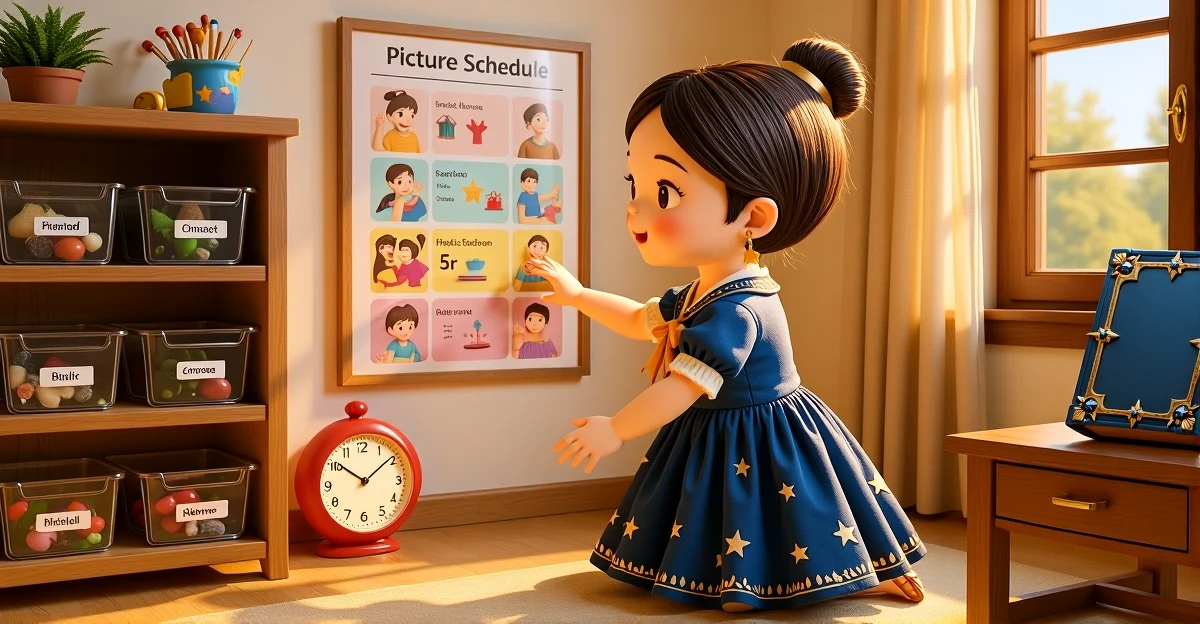
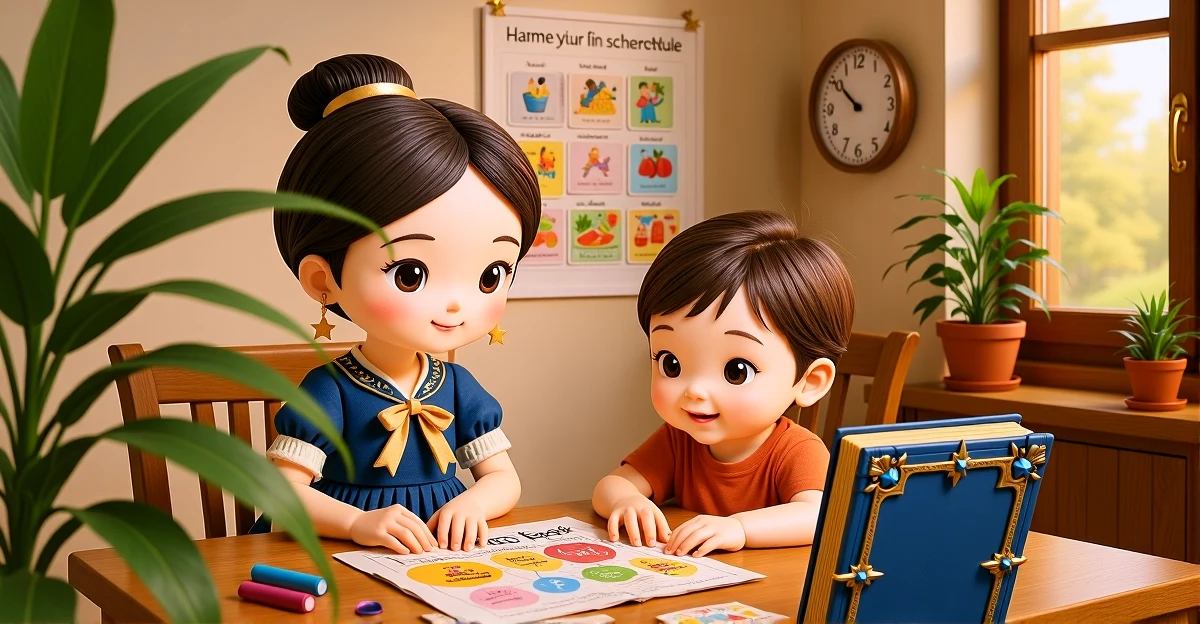
Now let's talk about the practical magic of visual schedules. These aren't complicated—they're simply picture representations of your daily routine that help your child SEE what comes next. When time becomes visible, it becomes real to a preschooler.
How to Create Your First Visual Schedule
- Start Simple: Choose 4-6 main activities in your daily routine. Maybe it's wake up, breakfast, play time, lunch, quiet time, and dinner. Don't try to map every single moment—just the anchors of your day.
- Use Pictures They Understand: You can draw simple pictures, use photos of your child doing each activity, or print clip art. An apple for snack time, a book for story time, a bathtub for bath time. The images should be clear and immediately recognizable to your child.
- Make It Interactive: Let your child help create the schedule! They can draw the pictures, choose the photos, or add stickers. When they're involved in making it, they're more invested in using it.
- Place It at Their Eye Level: Put the schedule where your child can see it easily—on the refrigerator, on their bedroom wall, or on a special board in your family command center.
- Reference It Throughout the Day: When your child asks "when," walk them to the schedule and show them. "See, we're at play time now. After play time comes lunch, and THEN we'll go to the park." You're teaching them to use the schedule as their own reference tool.
Different Types of Visual Schedules
You can create different schedules for different needs:
- Daily Routine Chart: Shows the flow of a typical day from morning to bedtime
- Morning Routine Checklist: Focuses just on getting ready (wake up, potty, get dressed, brush teeth, breakfast)
- Bedtime Routine Chart: Makes the evening predictable (dinner, bath, pajamas, teeth, story, bed)
- Special Day Schedule: For days that are different, like weekends or holidays
The key is consistency. Use the same schedule every day so your child's brain can recognize the pattern and build that internal sense of time's rhythm.
Beyond Schedules: Other Ways to Teach Time Awareness
Use Nature as Your Teacher
Take your child outside and notice the trees together. In autumn, collect leaves and talk about how they're changing. In spring, watch for the first flowers. The Magic Book reminds us that nature is the most beautiful teacher of time's passage, and it's right outside your door! When children observe seasonal changes, they're learning that time moves in cycles and patterns.
Practice Waiting in Small, Manageable Ways
If your child wants a cookie, you might say, "After we finish putting away these toys, then cookie time!" You're teaching them that time has a sequence, and that waiting doesn't mean never—it means not right now, but soon. And every time they successfully wait and then receive what they were waiting for, they're building that crucial skill of delayed gratification.
Start with very short waits—maybe just one minute while you finish washing your hands. Then gradually extend the time as they get more comfortable with the concept. You're building their capacity to tolerate the space between wanting and having, which is essentially what time management is all about.
Use Timers and Songs
For young children, a timer can make waiting visible. "We'll clean up when this timer beeps!" Or use songs as time markers: "We'll brush teeth for the whole ABC song." These concrete markers help children understand duration in a way that makes sense to them.
Talk About Time in Concrete Terms
Instead of saying "in an hour," try "after your nap" or "when the big hand is on the 12." Better yet, tie time to their routine: "We'll go to the park after lunch" or "Daddy comes home after we have our snack." You're giving them reference points they can understand.
Stories That Can Help
In The Book of Inara, we have beautiful stories that bring these concepts to life for your child. Stories are SUCH a powerful way to teach abstract concepts like time and responsibility because they make ideas concrete through characters and adventures.
The Sunshine Helpers
Perfect for: Ages 4-5 (also great for advanced 3-year-olds)
What makes it special: In this story, Ethan and Sofia discover that the solar panels at a community energy garden need gentle daily care to capture the most sunlight. They learn that when you take care of something regularly, with a predictable routine, both technology and nature flourish together. This story beautifully demonstrates that daily routines and responsibilities aren't boring—they're actually how we help beautiful things grow!
Key lesson: Just like Ethan and Sofia learn that the solar panels work best when they're cared for every day at the same time, your child can learn that their own daily routines help them grow strong and capable. After reading this story together, you could create your own daily care chart showing your child's responsibilities—maybe feeding the pet, watering a plant, or putting toys in the basket before bedtime.
When you read stories like The Sunshine Helpers together, you're not just spending time with your child—you're teaching them about time itself. You're showing them that routines aren't something that just happen TO them—they're something they're actively participating in, something that helps them and the world around them flourish.
The Deeper Gift: Building Capability and Trust
Here's something the Magic Book taught me that I want to share with you. When we give young children small, predictable responsibilities within a routine they can count on, we're not just teaching them about time. We're teaching them that they're capable, that they can be trusted, that they're growing up. And that sense of capability? It's one of the most precious gifts we can give a child.
Your child isn't asking when, when, when to annoy you. They're asking because they're trying to build a mental map of their day. They're trying to understand this mysterious thing called time that everyone keeps talking about. And every time you patiently answer, every time you point to the visual schedule and say, "See, snack time comes after we finish playing outside," you're helping them build that map.
You're teaching your child that time has a rhythm, that life has a flow, that they can count on certain things happening in a certain order. And that foundation of trust and predictability? It's going to serve them for the rest of their lives.
You're Doing Beautifully
So be patient with the constant questions. Be consistent with your routines. Be creative with your visual schedules. And most importantly, be proud of yourself for asking how to help your child learn and grow. That question alone tells me you're exactly the parent your child needs.
The beautiful truth is that you don't need to be perfect. You don't need an elaborate system or expensive materials. You just need to meet your child where they are, give them tools that match their developmental stage, and trust that their amazing brain is doing exactly what it's supposed to do—learning to understand the rhythm of time through the predictable love and routines you provide every single day.
Sweet dreams and beautiful routines, my wonderful friend. You've got this, and the Magic Book and I are always here to help.
With love and starlight,
Inara
Related Articles
- Why Your Child Can't Keep Track of Things (And How to Help Them Build Organization Skills)
- Why Your Child Doesn't Understand Consequences Yet (And How to Help)
- Building Your Child's Executive Function: Time Management & Organization (Ages 4-5)
- Why Morning Routines Feel Like Battles (And the Gentle Approach That Works)
- Nurturing Helpfulness in Young Children: A Gentle Parenting Guide
Show transcript
Hello, my wonderful friend! It's me, Inara, and I am so happy you're here today! You know, the Magic Book and I have been noticing something that so many parents are experiencing right now. Your little one keeps asking when, when, when—when are we going, when will it be time, when can I have my snack? And you're wondering, how do I help my three or four year old understand time when they can't even read a clock yet?
First, let me tell you something WONDERFUL. You're asking exactly the right question, and your child's constant questions about when are actually a beautiful sign that their brain is growing and developing! The Magic Book showed me that this is one of the most exciting phases of early childhood development.
Here's what's happening in your child's amazing little brain right now. At ages three and four, children are just beginning to grasp the concept of time, but it's still very abstract to them. Research from child development experts, including Dr. Lynn Meltzer from the Research Institute for Learning and Development, shows us that young children at this age naturally divide time into two categories—now and not now. That's it! And you know what? That's actually perfect for where they are developmentally.
Think about it this way. Your child can't tell time on a clock yet, and that's completely normal. But what they CAN do is learn to recognize patterns and sequences in their day. When you create predictable routines with visual cues, you're helping their developing brain understand that time flows in an order they can count on. And that sense of order? It's not just comforting, it's actually building the foundation for time management skills they'll use their whole life!
The National Association for the Education of Young Children teaches us something beautiful. Young children learn about time by observing patterns in nature and in their daily lives. When they see the leaves change colors with the seasons, when they notice that breakfast always comes before getting dressed, when they understand that story time happens after bath time—they're learning about time in a way that makes sense to their concrete, hands-on way of thinking.
Now, let me share what the Magic Book taught me about why this matters so much. Time management, at its most basic level, is really about the ability to delay gratification. It's about understanding that good things are coming, even if they're not happening right this second. And research shows that children who develop this skill early tend to have better study habits, better emotional regulation, and more success in school later on.
But here's the WONDERFUL part. You don't need fancy charts or complicated systems. What your child needs is simple, visual, and filled with connection.
Let me give you some practical ways to help your little one develop time awareness. First, create a picture schedule for your daily routine. Use simple drawings or photos that show the sequence of your day. An apple for snack time, a book for story time, a bathtub for bath time. When your child can SEE what comes next, time becomes something they can understand and predict. And that predictability? It's like a warm hug for their developing brain.
Second, use the changing seasons as your teacher. Take your child outside and notice the trees together. In autumn, collect leaves and talk about how they're changing. In spring, watch for the first flowers. The Magic Book reminds us that nature is the most beautiful teacher of time's passage, and it's right outside your door!
Third, practice waiting together in small, manageable ways. If your child wants a cookie, you might say, after we finish putting away these toys, then cookie time! You're teaching them that time has a sequence, and that waiting doesn't mean never—it means not right now, but soon. And every time they successfully wait and then receive what they were waiting for, they're building that crucial skill of delayed gratification.
Now, let me tell you about a story that shows this so beautifully. In The Book of Inara, we have a tale called The Sunshine Helpers. In this story, Ethan and Sofia discover that the solar panels at a community energy garden need gentle daily care to capture the most sunlight. They learn that when you take care of something regularly, with a predictable routine, both technology and nature flourish together.
This story is SPECIAL because it shows children that daily routines and responsibilities aren't boring—they're actually how we help beautiful things grow! Just like Ethan and Sofia learn that the solar panels work best when they're cared for every day at the same time, your child can learn that their own daily routines help them grow strong and capable.
After you read this story together, you could create your own daily care chart. Show your child their responsibilities—maybe feeding the pet, watering a plant, or putting their toys in the basket before bedtime. Just like the characters in the story care for the solar panels, your child is caring for their own special things. And suddenly, routines aren't something that just happen TO them—they're something they're actively participating in!
The Magic Book also taught me something about responsibility that I want to share with you. When we give young children small, predictable responsibilities within a routine they can count on, we're not just teaching them about time. We're teaching them that they're capable, that they can be trusted, that they're growing up. And that sense of capability? It's one of the most precious gifts we can give a child.
Here's another beautiful insight from the research. Ellen Dietrick, a preschool director who works with young children every day, reminds us that routines give children a comforting sense of order and predictability. In a world that can feel big and overwhelming to a three or four year old, knowing what comes next is like having a map. It helps them feel safe, secure, and ready to learn.
So what does this look like in your everyday life? Maybe it's a morning routine chart with pictures showing wake up, get dressed, eat breakfast, brush teeth. Maybe it's an afternoon chart showing lunch, quiet time, play time, snack. The specific activities don't matter as much as the consistency and the visual representation.
And here's something WONDERFUL—you can make this fun! Let your child help you create the chart. They can draw the pictures or choose photos. They can put stickers next to each activity when it's done. Suddenly, learning about time becomes a creative project you're doing together, not a lesson you're teaching at them.
The Magic Book whispers this truth to me, and I want to share it with you. Your child isn't asking when, when, when to annoy you. They're asking because they're trying to build a mental map of their day. They're trying to understand this mysterious thing called time that everyone keeps talking about. And every time you patiently answer, every time you point to the visual schedule and say, see, snack time comes after we finish playing outside, you're helping them build that map.
You're doing something beautiful, my friend. You're teaching your child that time has a rhythm, that life has a flow, that they can count on certain things happening in a certain order. And that foundation of trust and predictability? It's going to serve them for the rest of their lives.
So be patient with the constant questions. Be consistent with your routines. Be creative with your visual schedules. And most importantly, be proud of yourself for asking how to help your child learn and grow. That question alone tells me you're exactly the parent your child needs.
The Book of Inara is filled with stories that help children understand routines, responsibility, and the gentle rhythms of daily life. Stories like The Sunshine Helpers show children that taking care of things regularly helps them flourish. And when you read these stories together, you're not just spending time with your child—you're teaching them about time itself.
Sweet dreams and beautiful routines, my wonderful friend. You've got this, and the Magic Book and I are always here to help. With love and starlight, Inara.