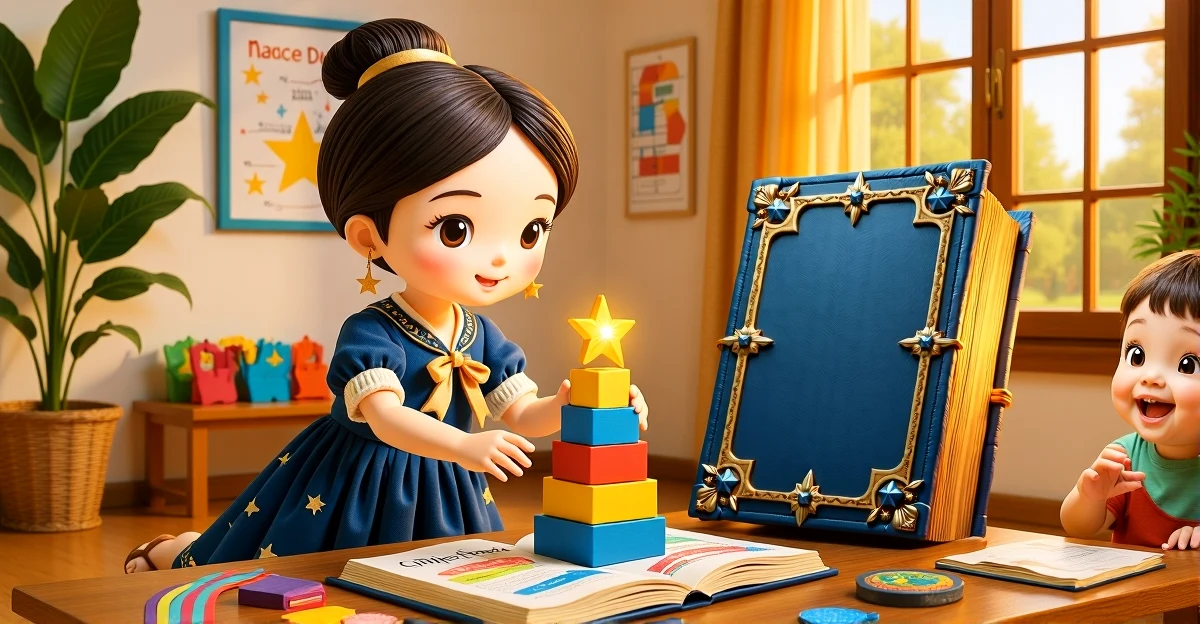

Hello, my wonderful friend! Have you been watching your three or four year old work so hard to build that tower, or try to put on their shoes all by themselves, or practice drawing circles over and over? And maybe, just maybe, you have seen those moments when frustration bubbles up, when they want to give up, when those big feelings take over?
You are not alone in this. In fact, you are witnessing something absolutely BEAUTIFUL. Your child is learning one of life most important skills, and this moment right here, with all its challenges and big feelings, is exactly where the magic happens.
Let me share what the Magic Book and I have learned about this incredible stage of development, and how you can support your child journey toward achievement with warmth, patience, and trust.
Understanding This Beautiful Stage of Development
When your preschooler is working toward a goal, whether it is stacking blocks, learning to zip their jacket, or trying to pour their own water, something WONDERFUL is happening in their amazing brain. Research from the National Academies of Sciences shows us that young children are natural learning masters with innate motivation for skill development.
Think about that for a moment. Your child was born with this incredible drive to learn, to grow, to master new skills. Ages three to four represent a critical developmental window for building self-efficacy and achievement motivation. Their developing executive function systems are just beginning to support goal-directed behavior, and every attempt they make is building pathways that will serve them for their entire life.
Why Frustration Is Actually a Gift
Here is something that might surprise you, my friend. When your child gets frustrated while trying something new, that frustration is not a problem to fix. It is actually a sign that learning is happening!
Frustration is what builds confidence and helps children know they can persist, in their own way and in their own time.
— Janet Lansbury, Parenting Educator and RIE Associate
Every time your child encounters a challenge and works through those big feelings, they are not just learning how to stack blocks or tie shoes. They are learning that they are capable, that effort matters, and that they can trust themselves to keep trying. This is SO important!
What Research Tells Us About Persistence
The research on goal-setting and persistence in preschool-aged children is absolutely fascinating. Studies demonstrate that when parents respond to children challenges with trust and emotional support rather than rescue or interference, children develop stronger persistence and confidence.
Janet Lansbury, a respected parenting educator, reminds us of something beautiful: When children are building skills and they get frustrated, they want to be the one to do the skill. They want to be able to do it themselves. So it does not help them if we come in and do it for them.
This is such an important insight! When we jump in to fix things or do tasks for our children, we are actually sending them a message that we do not believe they can do it. And when powerful people in their lives like us do not believe something, they start to not believe it either.
Process Over Outcomes
Here is another beautiful truth the Magic Book has taught me. Children at this age benefit from process-oriented approaches rather than outcome-focused pressure. Their developing brains are just beginning to understand goals and achievement, and when we focus on the joy of trying, the fun of practicing, the adventure of learning, we are actually supporting their brain development in the most wonderful way.
The Cook Center for Human Connection emphasizes that teaching goal-setting at a young age equips children with the mindset needed to navigate challenges, celebrate successes, and grow. But the key is celebrating effort and progress, not just completion or winning.
Gentle Strategies That Support Your Child
So what can we do to support our children as they learn this beautiful skill of persistence? How can we help them build confidence without taking away their power? Let me share some gentle strategies that really work.
1. Welcome Their Frustration
I know this might sound strange, but stay with me. When we normalize frustration instead of fearing it, we give our children permission to feel all their feelings while they learn. You might say something like, "You are working so hard on that! It can feel tricky sometimes, can it not?"
This tells your child that struggle is normal, that you see their effort, and that you trust them. It creates a safe space for them to experience the full range of emotions that come with learning.
2. Celebrate the Process, Not Just the Outcome
Instead of waiting until the tower is built to show excitement, notice each attempt. "You tried a different way that time!" or "You kept going even when it was challenging!" This helps children understand that every step matters, that progress is not always a straight line, and that their effort is what makes them amazing.
When we celebrate process over outcomes, we teach children that persistence matters more than perfection. This is the foundation of a growth mindset that will serve them throughout their lives.
3. Offer Just the Right Amount of Help
If your child asks for help, start with emotional support. Be present, be calm, show them you believe in them. Then, if they still need assistance, offer the smallest possible help. Maybe you hold one block steady while they place another. Maybe you start the zipper and let them pull it up.
This way, they still own the achievement, and they learn the skills they need. You are not rescuing them, you are supporting them in doing it themselves.
4. Trust Their Timeline
Sometimes our children need to step away from a challenge and come back to it later. That is perfectly okay! Trust that they know what they need. If they want to give up on building the tower right now and play with something else, that does not mean they have failed. It means they are regulating their emotions and will return when they are ready.
Age-appropriate expectations are essential. Preschoolers learn best through self-directed exploration with gentle guidance rather than performance pressure.
Stories That Can Help
In The Book of Inara, we have a beautiful story that brings these concepts to life for your child in the most magical way:
The Garden of Growing Steps
Perfect for: Ages 2-3 (also wonderful for 3-4 year olds)
What makes it special: Milo and Nana discover a magical practice garden where every small effort makes flowers bloom. They learn that their unique ways of trying are special gifts that help beautiful things grow. This story validates that progress happens through small steps and celebrates effort over outcomes.
Key lesson: When Milo and Nana see flowers bloom with each small effort they make, children learn something WONDERFUL. Every attempt matters and contributes to growth, even when the goal feels far away.
How to use it: After experiencing this story together with your child, you might create your own practice garden ritual at home. Celebrate each small step your child takes toward their goals with a flower drawing or sticker, making progress visible and joyful. Can you imagine how empowering that would be for your little one?
You Are Doing Beautifully
My wonderful friend, I want you to know something important. You do not have to be perfect at this. You just have to be present, trusting, and willing to let your child lead their own learning journey.
The next time your child is working toward something and gets frustrated, take a deep breath. Remember that this is exactly what is supposed to happen. Their frustration means their brain is growing. Their persistence means they believe in themselves. And your calm, trusting presence means they have exactly what they need to succeed.
The Magic Book reminds us that every child is on their own unique path, learning at their own pace, building their own beautiful garden of skills and confidence. Your role is not to make the path smooth or to carry them along it. Your role is to walk beside them, to believe in them, and to celebrate every single step they take.
You are doing such a beautiful job. Your child is so lucky to have you as their guide through this magical time of learning and growing.
The Magic Book and I are always here for you, cheering you on every step of the way. Until our next adventure together, with love and starlight, Inara.
Related Articles
- Understanding Your Child's Rough Play: A Gentle Guide to Teaching Empathy
- Teaching Your Preschooler Goal-Setting: The Science of Building Confidence Through Achievement
- Understanding Your Child Developing Goal-Setting Abilities (Ages 5-6)
- How to Help Your Child Set Goals and Achieve Them: A Gentle Guide
- Why Morning Routines Feel Like Battles (And the Gentle Approach That Works)
Show transcript
Hello, my wonderful friend! It's me, Inara, and I am SO happy you're here today. You know, the Magic Book and I have been noticing something truly beautiful happening in homes all around the world. Parents like you are watching their little ones discover something absolutely magical—the power of working toward a goal and celebrating every single step along the way.
Maybe your child is learning to build a tower, or trying to put on their shoes all by themselves, or working so hard to draw a circle. And sometimes, my friend, it can feel challenging when they get frustrated or want to give up. But here's what I want you to know—you're witnessing something WONDERFUL. Your child is learning one of life's most important skills, and you're exactly the guide they need.
Let me share what the Magic Book has taught me about this beautiful stage of development.
When your three or four year old is working toward a goal—whether it's stacking blocks, learning to zip their jacket, or trying to pour their own water—their amazing brain is building pathways that will serve them for their entire life. Research from the National Academies of Sciences shows us that young children are natural learning masters with innate motivation for skill development. Isn't that BEAUTIFUL?
Here's something that might surprise you. When your child gets frustrated while trying something new, that frustration isn't a problem to fix—it's actually a sign that learning is happening! Janet Lansbury, a respected parenting educator, reminds us that frustration is what builds confidence and helps children know they can persist, in their own way and in their own time.
Think about that for a moment. Every time your child encounters a challenge and works through those big feelings, they're not just learning how to stack blocks or tie shoes—they're learning that they are capable, that effort matters, and that they can trust themselves to keep trying.
Now, I know it can be so hard to watch your little one struggle. Your heart wants to jump in and help, to make it easier, to fix it for them. That's because you love them SO much! But here's what the Magic Book showed me—when children are building skills, what they truly want is to be the one to do it themselves. They're not frustrated because they want us to do it for them. They're frustrated because they want to be able to do it, and they're not quite there yet.
So what can we do to support them? How can we help them build this beautiful persistence without taking away their power?
First, we can welcome their frustration. I know that might sound strange, but stay with me. When we normalize frustration instead of fearing it, we give our children permission to feel all their feelings while they learn. You might say something like, "You're working so hard on that! It can feel tricky sometimes, can't it?" This tells them that struggle is normal, that you see their effort, and that you trust them.
Second, we can celebrate the process, not just the outcome. Instead of waiting until the tower is built to show excitement, we can notice each attempt. "You tried a different way that time!" or "You kept going even when it was challenging!" This helps children understand that every step matters, that progress isn't always a straight line, and that their effort is what makes them amazing.
Third, we can offer just the right amount of help—not too much, not too little. If your child asks for help, start with emotional support. Be present, be calm, show them you believe in them. Then, if they still need assistance, offer the smallest possible help. Maybe you hold one block steady while they place another. Maybe you start the zipper and let them pull it up. This way, they still own the achievement, and they learn the skills they need.
The research is so clear on this, my friend. When parents respond to children's challenges with trust and emotional support rather than rescue or interference, children develop stronger persistence and confidence. They learn that they are capable, that mistakes are part of learning, and that they can trust themselves to figure things out.
And here's something else the Magic Book taught me—children at this age benefit from process-oriented approaches rather than outcome-focused pressure. Their developing executive function systems are just beginning to support goal-directed behavior. So when we focus on the joy of trying, the fun of practicing, the adventure of learning, we're actually supporting their brain development in the most beautiful way.
Now, let me tell you about a story that shows this so perfectly. In The Book of Inara, there's a magical tale called "The Garden of Growing Steps." In this story, Milo and Nana discover a practice garden where every small effort makes flowers bloom. They learn that their unique ways of trying are special gifts that help beautiful things grow.
When Milo and Nana see flowers bloom with each small effort they make, children watching or listening learn something WONDERFUL—that every attempt matters and contributes to growth, even when the goal feels far away. The story validates that progress happens through small steps and celebrates effort over outcomes.
After experiencing this story together with your child, you might create your own practice garden ritual at home. You could celebrate each small step your child takes toward their goals with a flower drawing or sticker, making progress visible and joyful. Can you imagine how empowering that would be for your little one?
The Magic Book reminds us that teaching goal-setting at a young age equips children with the mindset needed to navigate challenges, celebrate successes, and grow. And the beautiful thing is, you don't have to be perfect at this. You just have to be present, trusting, and willing to let your child lead their own learning journey.
So the next time your child is working toward something and gets frustrated, take a deep breath. Remember that this is exactly what's supposed to happen. Their frustration means their brain is growing. Their persistence means they believe in themselves. And your calm, trusting presence means they have exactly what they need to succeed.
You're doing such a beautiful job, my friend. Your child is so lucky to have you as their guide through this magical time of learning and growing.
The Magic Book and I are always here for you, cheering you on every step of the way. Until our next adventure together, with love and starlight, Inara.