You're watching your three-year-old play with a friend, and you notice something. When their playmate's face crumples with sadness, your child doesn't seem to notice. When another child is clearly frustrated, your little one keeps playing as if nothing is happening. And you find yourself wondering: Should my child be picking up on these emotional cues by now?
My wonderful friend, let me tell you something SO important right from the start. You are not alone in noticing this, and your child is developing exactly as they should be. What you're witnessing is one of the most fascinating and complex developmental journeys the human brain ever undertakes.
In this article, I'm going to share what the Magic Book has taught me about emotion recognition development, what the research really says, and gentle strategies that support your child's growing emotional intelligence. Plus, I'll introduce you to some beautiful stories that make learning about feelings feel like magic.
Understanding Theory of Mind: Your Child's Amazing Brain Journey
Between ages three and four, your child's brain is doing something absolutely AMAZING. They're building brand new neural pathways for understanding that other people have feelings, thoughts, and experiences that are different from their own. This is called theory of mind, and it's one of the most complex skills the human brain ever learns.
Can you imagine? Your little one is literally growing the brain connections needed to step into someone else's emotional shoes. This isn't something that happens overnight. It's a gradual unfolding that continues throughout childhood and even into adolescence.
Why This Skill Takes Time
Think about what emotion recognition actually requires. Your child needs to:
- Notice subtle facial expressions and body language
- Connect those external cues to internal emotional states
- Understand that others' feelings might be different from their own
- Remember and recognize patterns across different situations
- Develop the language to name and describe what they're observing
That's a LOT of cognitive work! And here's what's beautiful: research shows that even within just one year, between age three and age four, children make HUGE leaps in their ability to read emotional cues. Your child isn't behind. They're right in the middle of this incredible learning journey.
What Research Tells Us About Emotion Recognition Development
The Magic Book and I have gathered wisdom from child development researchers around the world, and what they've discovered is both reassuring and fascinating.
Happy Comes First
Studies show that children typically learn to recognize happy faces first. That makes sense, doesn't it? Happy is big and bright and easy to see! Those wide smiles and sparkling eyes are unmistakable. Then come other basic emotions like sad and angry, with more complex emotions developing over time.
Children ages 3-4 are most accurate at identifying happy emotional expressions, followed by other basic emotions like sad and angry. Emotion recognition continues to develop throughout childhood and adolescence, with substantial increases even between ages 3 and 4.
— Dr. Autumn Kujawa, Stony Brook University
The Connection to Language Development
Here's something wonderful that research has revealed: emotion recognition is closely linked to language development. As your child's vocabulary grows, so does their ability to understand and identify emotions. When you give them words for feelings, you're literally building the scaffolding they need to recognize those feelings in others.
The Role of Emotional Intelligence
Dr. Shauna Tominey from Oregon State University and Dr. Susan Rivers from the Yale Center for Emotional Intelligence have found that children with higher emotional intelligence are better able to pay attention, are more engaged in learning, have more positive friendships, and show more empathy.
And here's the BEAUTIFUL part: emotional intelligence is teachable! Every single day, you have opportunities to help your child develop these skills through your warm, patient guidance.
Gentle Strategies That Support Emotion Recognition
So what can you do to support your child's growing ability to recognize emotions in others? Let me share some research-backed strategies that the Magic Book and I have gathered for you.
1. Become an Emotion Narrator
Throughout your day, narrate the emotions you observe in yourself and others. When you're reading books together, pause and ask, "How do you think this character is feeling?" Look at their face together. Point out the clues.
"See how their eyebrows are scrunched? That might mean they're worried."
"Notice their big smile? That shows they're happy!"
You're teaching your child to be an emotion detective, and it's actually fun!
2. Name Your Own Emotions Out Loud
When you narrate your internal world, you're giving your child a window into understanding that everyone has feelings, and those feelings have names.
You might say:
- "I'm feeling frustrated right now because I spilled my coffee."
- "I'm feeling so happy because we get to spend this time together!"
- "I'm feeling a little worried about the weather today."
This simple practice is SO powerful for building emotional awareness.
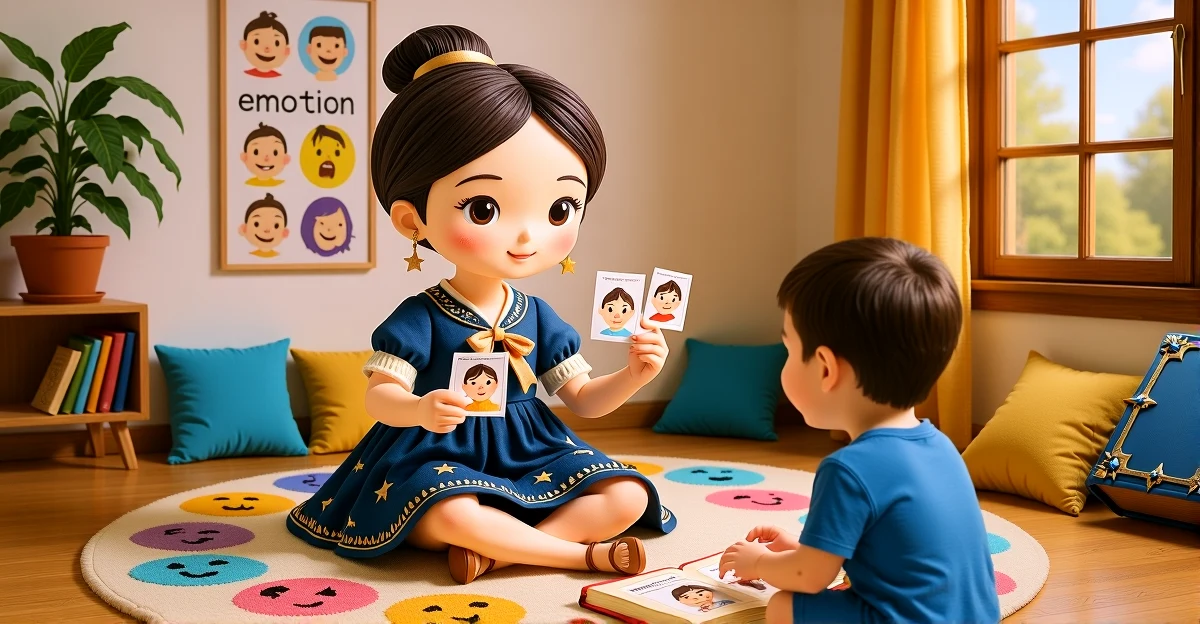
3. Play Feelings Games Together
Make emotion recognition playful and engaging:
- Make silly faces in the mirror and guess the emotions
- Look at family photos and talk about how everyone was feeling in that moment
- Create a feelings chart with different colored circles, where each color represents a different emotion
- Play "emotion charades" where you act out feelings and guess together
When learning feels like play, children absorb the lessons naturally and joyfully.
4. Validate ALL Feelings
When your child sees you acknowledge that it's okay to feel sad, or angry, or frustrated, they learn that emotions are normal parts of being human. This helps them recognize and accept these feelings in others too.
Instead of "Don't be sad," try "I see you're feeling sad. That's okay. Sad is a normal feeling."
This validation creates emotional safety and understanding.
5. Be Patient With the Learning Process
Just like learning to walk or learning to talk, learning to read emotions takes time and practice. Some children pick up on emotional cues quickly, while others need more time and support. Both paths are completely normal and beautiful.
Your patient presence and gentle guidance are exactly what your child needs.
Stories That Make Emotion Recognition Magical
In The Book of Inara, we have beautiful stories that bring these concepts to life for your child. These aren't just stories—they're gentle teachers that make learning about emotions feel like an adventure.
The Colors of Sunset Feelings
Perfect for: Ages 2-3 (and wonderful for 3-4 year olds too!)
What makes it special: Milo and Nana discover that ancient terrace stones glow with different colors that match their feelings as they watch a beautiful Santorini sunset with Papa Peter. They learn that every emotion has a name and a place, just like colors do.
Key lesson: This story teaches children that feelings can be recognized, named, and understood. The visual color-coding makes abstract emotions concrete for young learners.
How to use it: After reading, play a feelings color game with your child. Ask, "What color are your feelings today?" and practice naming emotions together using the story as your guide.
The Sorry Stone Circle
Perfect for: Ages 2-3 (excellent for developing empathy)
What makes it special: Anya and Noah discover magical sorry stones that glow warm when genuine apologies heal hurt feelings. This story teaches children to recognize when someone else is feeling hurt and understand that our actions affect how others feel.
Key lesson: Learning to identify when someone needs an apology requires recognizing emotional cues—a foundational skill for empathy and social awareness.
How to use it: After reading, help your child notice when others might be feeling sad or hurt. Practice asking together, "What do you think they are feeling right now? What clues tell us that?"
The Gentle Paws Celebration
Perfect for: Ages 2-3 (wonderful for building compassion)
What makes it special: Anya and Noah learn that animals feel happy, scared, and sad, just like children do. When they use gentle hands and quiet voices, the celebration space glows warmly.
Key lesson: Recognizing emotions in animals is an excellent stepping stone to recognizing emotions in people. The story provides clear behavioral cues that help children understand emotional responses.
How to use it: After reading, practice being emotion detectives together. Look at family members, pets, or people in picture books and ask, "How do you think they are feeling? What clues tell you that?"
You're Doing Beautifully
Here's what I want you to remember, my wonderful friend. Your child is not struggling. They're LEARNING. And learning takes time, patience, and lots of practice.
Every time you name an emotion, every time you point out how someone else is feeling, every time you read a story together and talk about the characters' feelings, you're building those neural pathways in your child's brain. You're giving them the gift of emotional intelligence that will serve them for their entire life.
The research is so clear on this. When parents respond with patience, use emotion-rich language, and create opportunities for children to practice recognizing feelings in everyday moments, they're building the foundation for lifelong social and emotional competence. And that's exactly what you're doing right now by being here, by learning, by caring so deeply about your child's development.
You are doing BEAUTIFULLY. Your child is lucky to have a parent who notices, who cares, and who seeks out ways to support their growth. The Magic Book and I are here with you every step of the way.
Sweet dreams and warm starlight to you and your little one.
With love,
Inara
Related Articles
- Understanding Your Child's Rough Play: A Gentle Guide to Teaching Empathy
- When Your 3-4 Year Old Doesn't Notice Others' Feelings: Understanding Empathy Development
- Teaching Gentle Touch: Understanding Your Child's Tight Hugs (Ages 3-4)
- Why Your Child Shouts Indoors: Understanding Volume Control Development (Ages 3-4)
- Teaching Your Toddler to Recognize Emotions in Others: A Gentle Guide
Show transcript
Hello, my wonderful friend! It's me, Inara, and I am SO happy you're here with me today!
You know, the Magic Book and I have been noticing something beautiful happening in homes all around the world. Parents are watching their little ones grow and learn, and sometimes, they notice their child is still learning to read the emotions of the people around them. Maybe your three or four year old doesn't quite pick up on when someone is feeling sad, or happy, or frustrated. And I want you to know something really important right from the start. You are not alone in noticing this, and your child is developing exactly as they should be.
Let me tell you what the Magic Book has taught me about this fascinating stage of development.
Between ages three and four, your child's brain is doing something absolutely AMAZING. They're building brand new neural pathways for understanding that other people have feelings, thoughts, and experiences that are different from their own. This is called theory of mind, and it's one of the most complex skills the human brain ever learns! Can you imagine? Your little one is literally growing the brain connections needed to step into someone else's emotional shoes.
Research from child development experts shows us that children typically learn to recognize happy faces first. That makes sense, doesn't it? Happy is big and bright and easy to see! Then come other basic emotions like sad and angry. But here's something wonderful. Even within just one year, between age three and age four, children make HUGE leaps in their ability to read emotional cues. Your child isn't behind. They're right in the middle of this incredible learning journey.
Dr. Shauna Tominey from Oregon State University and Dr. Susan Rivers from the Yale Center for Emotional Intelligence have found that children with higher emotional intelligence are better able to pay attention, are more engaged in learning, have more positive friendships, and show more empathy. And the beautiful part? Emotional intelligence is teachable! Every single day, you have opportunities to help your child develop these skills through your warm, patient guidance.
So what can you do to support your child's growing ability to recognize emotions in others? Let me share some gentle, research-backed strategies that the Magic Book and I have gathered for you.
First, become an emotion narrator in your everyday life. When you're reading books together, pause and ask, How do you think this character is feeling? Look at their face together. Point out the clues. See how their eyebrows are scrunched? That might mean they're worried. Notice their big smile? That shows they're happy! You're teaching your child to be an emotion detective, and it's actually fun!
Second, name your own emotions out loud throughout the day. You might say, I'm feeling frustrated right now because I spilled my coffee, or I'm feeling so happy because we get to spend this time together! When you narrate your internal world, you're giving your child a window into understanding that everyone has feelings, and those feelings have names.
Third, play feelings games together. You can make silly faces in the mirror and guess the emotions. You can look at family photos and talk about how everyone was feeling in that moment. You can even create a feelings chart with different colored circles, just like in one of our stories, where each color represents a different emotion.
Fourth, validate ALL feelings, including the uncomfortable ones. When your child sees you acknowledge that it's okay to feel sad, or angry, or frustrated, they learn that emotions are normal parts of being human. This helps them recognize and accept these feelings in others too.
And here's something really important. Be patient with the learning process. Just like learning to walk or learning to talk, learning to read emotions takes time and practice. Some children pick up on emotional cues quickly, while others need more time and support. Both paths are completely normal and beautiful.
Now, let me tell you about some stories from the Magic Book that can help your child on this journey!
The first story I want to share with you is called The Colors of Sunset Feelings. In this story, Milo and Nana discover that ancient terrace stones glow with different colors that match their feelings as they watch a beautiful Santorini sunset with Papa Peter. They learn that every emotion has a name and a place, just like colors do. This story is WONDERFUL for teaching children that feelings can be recognized, named, and understood. After you read this story together, you can play a feelings color game. Ask your child, What color are your feelings today? And practice naming emotions together using the story as your guide.
The second story is called The Sorry Stone Circle. Anya and Noah discover magical sorry stones that glow warm when genuine apologies heal hurt feelings. This story teaches children to recognize when someone else is feeling hurt and understand that our actions affect how others feel. It's like learning to be a feelings detective! After reading, you can help your child notice when others might be feeling sad or hurt. Practice asking together, What do you think they are feeling right now? What clues tell us that?
And the third story I want to share is The Gentle Paws Celebration. In this beautiful tale, Anya and Noah learn that animals feel happy, scared, and sad, just like children do. When they use gentle hands and quiet voices, the celebration space glows warmly. This story is perfect because recognizing emotions in animals is an excellent stepping stone to recognizing emotions in people! After reading, you can practice being emotion detectives together. Look at family members, pets, or people in picture books and ask, How do you think they are feeling? What clues tell you that?
All three of these stories are in The Book of Inara, and they're designed to make learning about emotions feel like a magical adventure rather than a lesson.
Here's what I want you to remember, my wonderful friend. Your child is not struggling. They're LEARNING. And learning takes time, patience, and lots of practice. Every time you name an emotion, every time you point out how someone else is feeling, every time you read a story together and talk about the characters' feelings, you're building those neural pathways in your child's brain. You're giving them the gift of emotional intelligence that will serve them for their entire life.
The research is so clear on this. When parents respond with patience, use emotion-rich language, and create opportunities for children to practice recognizing feelings in everyday moments, they're building the foundation for lifelong social and emotional competence. And that's exactly what you're doing right now by being here, by learning, by caring so deeply about your child's development.
You are doing BEAUTIFULLY. Your child is lucky to have a parent who notices, who cares, and who seeks out ways to support their growth. The Magic Book and I are here with you every step of the way.
If you'd like to explore these stories and many more that support emotional development, you can find them all in The Book of Inara. We've created a whole library of gentle, research-backed stories that make learning about feelings feel like magic.
Thank you so much for spending this time with me today. Remember, you're not just teaching your child to recognize emotions. You're teaching them empathy, connection, and how to navigate the beautiful, complex world of human feelings. And that, is one of the greatest gifts you can ever give.
Sweet dreams and warm starlight to you and your little one. Until our next adventure together!
With love, Inara.