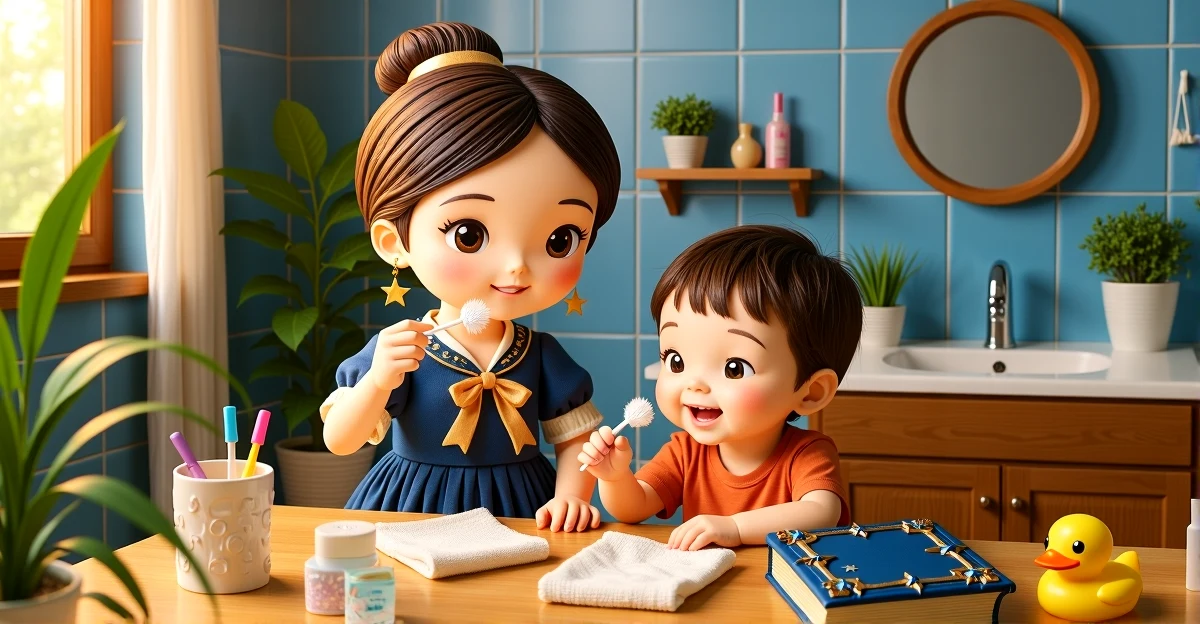

It's the third time this morning you've asked your four-year-old to brush their teeth. The toothbrush sits untouched on the counter. Your child is suddenly VERY interested in a toy they haven't looked at in weeks. You feel your patience wearing thin. Sound familiar?
If your child resists self-care routines like tooth-brushing, hand-washing, or getting dressed, I want you to know something really important right now. You are not alone in this. This is one of the MOST common challenges parents face with four and five-year-olds, and there's a beautiful developmental reason why.
In this post, we're going to explore what's really happening when your child resists self-care, what the research tells us about this stage, and most importantly, gentle strategies that actually work to transform these moments from battles into opportunities for connection.
What's Really Happening (It's Not Defiance)
Here's something the Magic Book taught me that changed everything. When your four or five-year-old refuses to brush their teeth or wash their hands, they're not being difficult. They're not trying to make your life harder. What they're actually doing is something WONDERFUL.
They're discovering their independence.
Think about it from their perspective. For the first few years of life, everything happened TO them. You dressed them, you fed them, you washed them. But now? Now their brain is developing in remarkable ways. They're learning that they have their own ideas, their own preferences, their own sense of agency in the world.
Their brain is literally wiring itself to think, "I am my own person. I can make choices. I have power over my own body." And that is BEAUTIFUL. That's exactly what we want them to learn.
But here's the thing. When that beautiful independence-seeking bumps up against necessary routines like tooth-brushing or hand-washing, it can feel like a battle. Your child's brain is saying, "I want to decide!" And your parent brain is saying, "But we HAVE to brush teeth!" And suddenly, what should be a simple two-minute routine becomes a power struggle.
The Science of Autonomy Development
Research from child development experts at the University of Alberta shows us that ages four and five are a pivotal developmental window. This is when children are naturally building autonomy and independence.
"When parents demonstrate greater positive guidance and responsiveness and less negative control, children display higher levels of autonomy during everyday activities."
— Dr. Christina Rinaldi, Professor of Educational Psychology, University of Alberta
Dr. Rinaldi and her research team discovered something fascinating. When parents use what they call autonomy supportive behaviors - positive guidance, responsiveness, and minimal controlling actions - children display significantly higher levels of cooperation and independent behavior. In other words, when we support their autonomy instead of fighting against it, they actually WANT to participate.
The Children's Hospital of Orange County confirms that ages 4-5 are critical for developing independence in self-care, as children are building foundational skills for school readiness and personal responsibility. During this stage, young children are developing the motor skills, cognitive abilities, and self-motivation needed to participate in daily tasks.
So when your child resists, they're not being "bad." They're developing exactly as they should. The resistance is actually a sign of healthy brain development.
Gentle Strategies That Actually Work
So what do we do? How do we honor their growing independence while still making sure they develop healthy self-care habits? The Magic Book whispers this wisdom: The secret isn't in controlling the routine. It's in inviting cooperation through connection and playfulness.
1. Offer Choices Within the Routine
Instead of saying, "Go brush your teeth right now," try this: "Would you like to brush your teeth before or after we read our story?" Or, "Do you want to use the blue toothbrush or the green one today?"
You're still guiding them toward the self-care task, but you're honoring their need to have some control. They get to make a choice, and that feels empowering to their growing brain. This simple shift can transform resistance into cooperation.
2. Make It Playful
Children's Hospital of Orange County reminds us that children at this age learn best through play. So what if tooth-brushing became a silly song? What if hand-washing turned into a bubble-making game? What if getting dressed became a race against a timer, but a fun one where everyone wins?
When we add playfulness to routines, we're not just making them more enjoyable. We're actually helping our children's brains associate self-care with positive feelings. And THAT creates habits that last a lifetime.
3. Model the Behavior with Enthusiasm
Your child is watching you. When they see you brushing your teeth with a smile, when they hear you say, "Mmm, I love how fresh my teeth feel after brushing," their mirror neurons light up. They think, "Oh, this is something people who I love do. This is something that feels good."
UNICEF parenting experts emphasize that children learn self-care skills best through modeling and positive reinforcement, not through criticism or power struggles. So let them see you taking care of yourself, and let them see that you genuinely enjoy it.
4. Create Connection Time First
This is SO important. Often, resistance to self-care routines is really about something deeper. Your child might be saying, "I don't want to brush teeth," but what they're really communicating is, "I'm not ready to leave you yet. I want more time with you."
So what if, before you start the bedtime routine, you spent just five extra minutes of pure connection time? Maybe you snuggle on the couch, or you play a quick game, or you just talk about their day. When their connection cup is full, they're so much more willing to cooperate with routines.
5. Stay Curious About Sensory Experiences
Sometimes, the resistance isn't about independence at all. Sometimes, it's about the sensory experience. Maybe the toothbrush feels too scratchy. Maybe the water is too cold. Maybe the soap smells too strong.
When we stay curious and ask gentle questions - "What doesn't feel good about this? How can we make this more comfortable for you?" - we show our children that their feelings matter, and we often discover simple solutions.
Stories That Can Help
In The Book of Inara, we have beautiful stories that bring these concepts to life for your child. Let me share one that's perfect for this challenge:
The Shy Plant's Garden Song
Perfect for: Ages 4-5
What makes it special: This story beautifully models how care routines can become joyful, connected experiences. When Ethan and Maeva discover a lonely plant in a magical singing greenhouse, they learn that including the shy plant in their care routine with gentle touches and dancing creates something magical - the whole garden creates more beautiful music together.
Key lesson: The plant that seemed resistant at first blooms into cooperation when approached with gentleness and joy. This shows children that care routines can be connecting, joyful, even magical when we approach them with love.
How to use it: After reading this story with your child, you might try creating your own tooth-brushing song, or your own hand-washing dance. You might discover that when self-care becomes a moment of connection rather than a command, everything shifts.
You're Doing Beautifully
My wonderful friend, I want you to know this. If self-care routines have been a struggle in your house, that doesn't mean you're doing anything wrong. It means your child is developing exactly as they should. They're discovering their independence. They're learning about their own preferences and boundaries.
And with your gentle guidance, they're learning that they can be independent AND cooperative. They can have their own ideas AND participate in necessary routines. That's beautiful work you're doing.
The research is so clear on this. When parents respond to resistance with patience and playfulness instead of frustration, children develop better emotional regulation, stronger parent-child relationships, and more successful independence skills over time. You're not just getting your child to brush their teeth. You're teaching them that taking care of themselves can feel good. That their body deserves gentle care. That routines can be moments of connection.
Every time you stay calm during resistance, every time you offer a choice, every time you make a routine playful instead of forceful, you're building your child's sense of autonomy AND their trust in you.
The Magic Book and I are always here for you, offering stories and wisdom to support your journey. You've got this.
With love and starlight,
Inara
Related Articles
- Why Morning and Bedtime Routines Feel Like Battles (And How to Transform Them)
- Building Confidence in Young Performers: A Gentle Guide for Ages 4-5
- Understanding Your Child's Growing Independence: Why They Won't Do Things They're Capable Of (Ages 4-5)
- Understanding Regression in Preschoolers: Why Your Child Acts Younger and How to Help
- Understanding Bathroom Anxiety in Young Children (And How to Help)
Show transcript
Hello, my wonderful friend! It's me, Inara, and I am SO happy you're here with me today!
You know, the Magic Book and I have been noticing something lately. So many parents are reaching out about self-care routines with their four and five-year-olds. Maybe your little one refuses to brush their teeth, or turns hand-washing into a battle, or just seems to resist every single self-care task. And I want you to know something really important right now. You are not alone in this. This is one of the MOST common challenges parents face at this age, and there's a beautiful reason why.
So grab a cozy cup of tea, settle in with me, and let's talk about what's really happening when your child resists self-care routines, and more importantly, how we can transform these moments from struggles into opportunities for connection.
First, let me share something the Magic Book taught me that changed everything. When your four or five-year-old resists brushing their teeth or washing their hands, they're not being difficult. They're not trying to make your life harder. What they're actually doing is something WONDERFUL. They're discovering their independence. They're learning that they have their own ideas, their own preferences, their own sense of agency in the world.
Research from child development experts at the University of Alberta shows us that ages four and five are a pivotal developmental window. This is when children are naturally building autonomy and independence. Their brains are literally wiring themselves to think, I am my own person. I can make choices. I have power over my own body. And that is BEAUTIFUL! That's exactly what we want them to learn.
But here's the thing. When that beautiful independence-seeking bumps up against necessary routines like tooth-brushing or hand-washing, it can feel like a battle. Your child's brain is saying, I want to decide! And your parent brain is saying, But we HAVE to brush teeth! And suddenly, what should be a simple two-minute routine becomes a power struggle.
So what do we do? How do we honor their growing independence while still making sure they develop healthy self-care habits?
The Magic Book whispers this wisdom. The secret isn't in controlling the routine. It's in inviting cooperation through connection and playfulness.
Dr. Christina Rinaldi and her research team discovered something fascinating. When parents use what they call autonomy supportive behaviors, positive guidance, responsiveness, and minimal controlling actions, children display significantly higher levels of cooperation and independent behavior. In other words, when we support their autonomy instead of fighting against it, they actually WANT to participate.
Let me share some gentle strategies that work beautifully.
First, offer choices within the routine. Instead of saying, Go brush your teeth right now, try this. Would you like to brush your teeth before or after we read our story? Or, Do you want to use the blue toothbrush or the green one today? You're still guiding them toward the self-care task, but you're honoring their need to have some control. They get to make a choice, and that feels empowering to their growing brain.
Second, make it playful. Children's Hospital of Orange County reminds us that children at this age learn best through play. So what if tooth-brushing became a silly song? What if hand-washing turned into a bubble-making game? What if getting dressed became a race against a timer, but a fun one where everyone wins?
When we add playfulness to routines, we're not just making them more enjoyable. We're actually helping our children's brains associate self-care with positive feelings. And THAT creates habits that last a lifetime.
Third, model the behavior with enthusiasm. Your child is watching you. When they see you brushing your teeth with a smile, when they hear you say, Mmm, I love how fresh my teeth feel after brushing, their mirror neurons light up. They think, Oh, this is something people who I love do. This is something that feels good.
UNICEF parenting experts emphasize that children learn self-care skills best through modeling and positive reinforcement, not through criticism or power struggles. So let them see you taking care of yourself, and let them see that you genuinely enjoy it.
Fourth, create connection time right before the routine. This is SO important. Often, resistance to self-care routines is really about something deeper. Your child might be saying, I don't want to brush teeth, but what they're really communicating is, I'm not ready to leave you yet. I want more time with you.
So what if, before you start the bedtime routine, you spent just five extra minutes of pure connection time? Maybe you snuggle on the couch, or you play a quick game, or you just talk about their day. When their connection cup is full, they're so much more willing to cooperate with routines.
And here's something else the Magic Book showed me. Sometimes, the resistance isn't about independence at all. Sometimes, it's about the sensory experience. Maybe the toothbrush feels too scratchy. Maybe the water is too cold. Maybe the soap smells too strong. When we stay curious and ask gentle questions, What doesn't feel good about this? How can we make this more comfortable for you? we show our children that their feelings matter, and we often discover simple solutions.
Now, I want to tell you about a story that illustrates this so beautifully. It's called The Shy Plant's Garden Song, and it's about Ethan and Maeva discovering a lonely plant in a magical singing greenhouse.
In the story, the children learn that when they include the shy plant in their care routine with gentle touches and dancing, something magical happens. The whole garden creates more beautiful music together. The plant that seemed resistant at first blooms into cooperation when approached with gentleness and joy.
This story shows children that care routines can be connecting, joyful, even magical when we approach them with love. And it shows parents that the secret to cooperation isn't force. It's invitation. It's making the experience something we do together, with gentleness and playfulness.
After you read this story with your child, you might try creating your own tooth-brushing song, or your own hand-washing dance. You might discover that when self-care becomes a moment of connection rather than a command, everything shifts.
The research is so clear on this. When parents respond to resistance with patience and playfulness instead of frustration, children develop better emotional regulation, stronger parent-child relationships, and more successful independence skills over time. You're not just getting your child to brush their teeth. You're teaching them that taking care of themselves can feel good. That their body deserves gentle care. That routines can be moments of connection.
And my wonderful friend, I want you to know this. If self-care routines have been a struggle in your house, that doesn't mean you're doing anything wrong. It means your child is developing exactly as they should. They're discovering their independence. They're learning about their own preferences and boundaries. And with your gentle guidance, they're learning that they can be independent AND cooperative. They can have their own ideas AND participate in necessary routines.
You're doing such important work. Every time you stay calm during resistance, every time you offer a choice, every time you make a routine playful instead of forceful, you're building your child's sense of autonomy AND their trust in you. That's beautiful.
The Magic Book and I are always here for you. You can find The Shy Plant's Garden Song and so many other helpful stories in The Book of Inara. These stories are like gentle teachers, showing children through beautiful narratives what we want them to learn.
Thank you for being here with me today. Thank you for caring so deeply about your child's development. And remember, you've got this. With love and starlight, Inara.