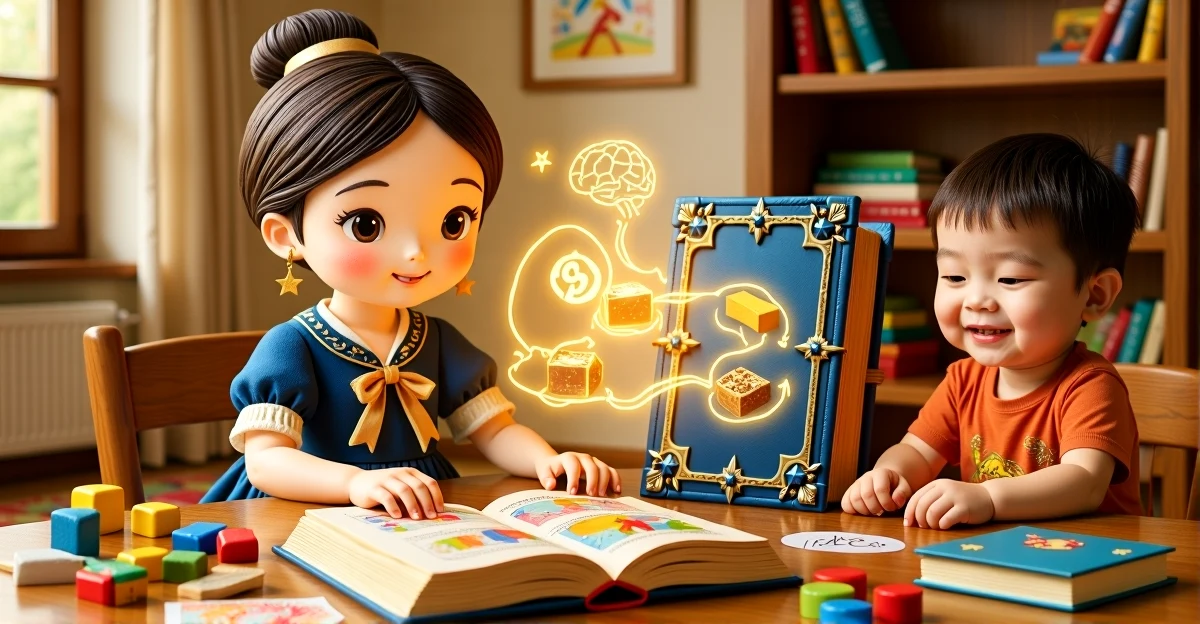

Hello, my wonderful friend. If you're reading this, there's a good chance your six or seven year old is finding some schoolwork challenging right now. Maybe they're struggling with complex math concepts, or reading comprehension isn't clicking the way you hoped it would. Maybe they get frustrated when abstract ideas don't make sense right away, and you're starting to worry. Is something wrong? Are they falling behind?
The Magic Book and I want you to take a deep breath, because we're about to share something IMPORTANT with you. What you're seeing isn't a problem. It's not a deficit. It's beautiful, normal brain development happening exactly as it should. Your child's brain is in the middle of one of the most fascinating transitions in all of human development, and understanding what's happening will change everything about how you support them.
In this post, we're going to explore what child development research tells us about how six and seven year olds think, why abstract concepts are still challenging at this age, and most importantly, gentle strategies that actually help. Plus, I'll share a story from The Book of Inara that beautifully shows children that their questions and unique thinking have real value, even when they don't understand everything yet.
The Beautiful Brain Transition Happening Right Now
Here's what the Magic Book taught me that changed everything. Your child's brain is moving from what child development experts call the preoperational stage into the concrete operational stage. Now, I know those sound like big fancy words, but here's what they really mean in your everyday life.
In the preoperational stage, which lasts from about ages two to seven, children think in wonderfully imaginative, fantasy-based ways. Their stuffed animals have feelings, the moon follows them in the car, and magic is absolutely real. It's a beautiful stage of development, and it's exactly what their brains are supposed to be doing.
But around age seven, something shifts. Children begin entering the concrete operational stage, which lasts until about age eleven. This is when their thinking becomes more logical and organized, but here's the key: they can think logically about things they can see, touch, and manipulate. Abstract thinking, the kind needed for complex math concepts, hypothetical scenarios, or invisible ideas, that's still growing. It's like a beautiful flower that hasn't quite bloomed yet.
Children at this age can manipulate concrete objects mentally, but they're still developing the capacity for abstract reasoning and hypothetical thinking.
— Dr. Michelle Anthony, Child Development Specialist
What This Looks Like in Real Life
Think about it this way. If you show your child two rows of pennies with the same number in each row, they can understand that they're equal even if one row is spread out to look longer. That's concrete thinking, and they're getting really good at it. Their brain can now understand that the quantity stays the same even when the appearance changes, as long as they can SEE the pennies.
But ask them to imagine what would happen if we changed the rules of addition, or to think about a math problem with no physical objects to count, and their brain says, "Wait, I'm not quite ready for that yet." And you know what? That's perfect. That's exactly where they should be developmentally.
What Child Development Research Tells Us
The research on this developmental stage is SO reassuring. The National Academies of Sciences did extensive research showing that mathematical understanding and reading comprehension actually develop together in seven year olds. Each skill supports the other, like two friends helping each other climb a mountain.
So when your child is working on reading comprehension, they're also building the thinking skills they need for math. And when they're practicing math, they're strengthening the logical thinking that helps with reading. Isn't that beautiful? Their brain is doing SO much more than we can see on the surface.
Here's something else that's WONDERFUL. This developmental phase is also when metacognition begins to emerge. That's a fancy word for thinking about thinking. Your child is starting to understand what they need to do to learn better. They might realize they need to reread a passage, or ask a question, or try a different strategy. This is huge cognitive growth, even if it doesn't look like mastery yet.
Children's learning is enhanced through structured social interactions and scaffolded support from knowledgeable adults.
— National Academies of Sciences, Engineering, and Medicine
That knowledgeable adult? That's you. You don't need to be a math expert or a reading specialist. You just need to be present, patient, and willing to break things down into manageable pieces.
The Growth Mindset Game-Changer
Now I want to talk about something that Stanford professor Carol Dweck discovered, because this is going to change how you support your child through academic challenges. Her research on growth mindset shows that when children understand that learning challenging concepts takes time and effort, they develop greater resilience and persistence.
Here's the key, and this is SO important. When we praise our children for their effort and their strategies, rather than telling them they're just naturally smart, they learn that struggle is part of learning, not a sign of failure.
The Language That Changes Everything
Instead of saying: "You're so smart!"
Try saying: "I love how you kept trying different strategies until you figured that out."
Do you see the difference? One makes them think their ability is fixed. The other shows them that their brain grows through effort. When your child encounters a challenging math problem and says, "I can't do this," you can gently add one powerful word: "You can't do this YET. Your brain is still learning, and that's exactly what it's supposed to be doing."
Teaching children that struggle is a normal part of learning reduces anxiety and increases engagement with challenging material.
— Stanford Teaching Commons, based on research by Carol Dweck, PhD
Gentle Strategies That Actually Work
The Magic Book whispers this truth: Every child's brain develops at its own perfect pace. Some children grasp abstract concepts a little earlier, some a little later, but all of them get there when their brain is ready. Your job isn't to rush that process. Your job is to provide what Dr. Anthony calls structured support and consistent direction.
Here are gentle, research-backed strategies that help:
Make It Concrete
- Use objects they can touch and manipulate. When working on math, use blocks, beads, or coins. Let them physically move objects around to understand concepts like addition, subtraction, or grouping.
- Draw pictures and diagrams. Visual representations help bridge the gap between concrete and abstract thinking. Let your child draw out word problems or create visual maps of story sequences.
- Connect to real life. Abstract concepts become concrete when tied to everyday experiences. "If we have three apples and eat one, how many are left?" is much easier than "3 minus 1 equals what?"
Break It Down
- Chunk complex concepts into smaller steps. Don't present the whole problem at once. Break it into tiny, manageable pieces that build on each other.
- Be patient when they need to ask the same question multiple times. That's how their brain builds understanding, layer by layer, like building a beautiful castle one block at a time.
- Celebrate small wins. Every tiny step forward is brain growth happening. Acknowledge it!
Create a Safe Space for Struggle
- Normalize not knowing. Share times when you didn't understand something right away. Model that learning takes time.
- Praise the process, not just the outcome. "I noticed you tried three different ways to solve that. That's what good learners do!"
- Remove time pressure. When children feel rushed, their thinking shuts down. Give them space to work through challenges at their own pace.
Use Stories as Teaching Tools
- Stories make abstract concepts concrete. When children see characters working through challenges, they internalize those lessons in ways that direct instruction can't achieve.
- Stories validate their experience. Seeing characters struggle and succeed helps children understand that challenge is normal and temporary.
- Stories spark conversations. After reading together, you can talk about how the character's experience relates to what your child is going through.
A Story That Can Help
Speaking of stories, let me tell you about one that the Magic Book and I think will be SO helpful for you and your child right now. It's called The Dreamship Architects, and it's available in The Book of Inara.
The Dreamship Architects
Perfect for: Ages 6-7
What makes it special: This story is about two boys, Theo and Miles, who visit their fathers' office where they're designing generation ships for space travel. Now, these are complex, difficult problems that even the brilliant adult scientists are struggling with. The engineering is complicated, the concepts are abstract, and the challenges seem impossible.
But here's what's WONDERFUL. When Theo and Miles start asking their innocent questions, when they touch the holographic blueprints with their curious young hands, something magical happens. The designs start to glow, and the fathers realize that the children's questions, their unique way of thinking, holds the key to solving problems the adults couldn't crack alone.
Key lesson: This story teaches something so beautiful. It shows children that their questions have value, that their way of thinking matters, even when they don't understand everything yet. Theo asks philosophical questions about why people need purpose on long journeys, and Miles thinks strategically about how to design spaces that keep purpose alive. Neither boy understands all the complex engineering, but their perspectives are exactly what's needed.
Why it helps with academic challenges: After you read this story with your child, you can talk about how Theo and Miles helped solve a problem by asking questions and thinking in their own unique way. You can celebrate your child's questions about difficult concepts, explaining that just like Theo and Miles, their way of thinking is valuable and important. When they struggle with abstract math, you can remind them that their brain is still learning to think about invisible concepts, and that's okay. The questions they ask, the strategies they try, those are all part of their brain growing stronger.
And you know what the story teaches? That learning never stops growing. Even the smartest adults are still learning, still asking questions, still discovering new things. What a beautiful message for a child who feels frustrated by what they don't know yet.
You're Doing Beautifully
Here's what I want you to remember, my wonderful friend. Your child is not behind. They're not struggling because something is wrong. They're in a natural developmental phase where concrete thinking is strong and abstract thinking is still emerging. This is temporary. This is normal. This is beautiful.
Your patient, structured support, your celebration of their effort, your willingness to break concepts down into touchable, visible pieces, that's exactly what they need. You don't need to be perfect. You don't need to have all the answers. You just need to be present, encouraging, and willing to learn alongside them.
The Magic Book and I believe in you, and we believe in your child. Every question they ask, every time they try a new strategy, every moment they spend wrestling with a challenging concept, their brain is growing. Neural pathways are forming. Understanding is building. And one day, sooner than you think, those abstract concepts will start to click, and you'll look back on this time and see it for what it really was. Not a struggle, but a beautiful journey of growth.
Find The Dreamship Architects in The Book of Inara, and let it remind both you and your child that learning is a lifelong adventure, that questions are treasures, and that every brain develops at its own perfect pace.
You're doing beautifully. Your child is lucky to have you.
With love and starlight,
Inara
Related Articles
- How to Nurture Your Child's Empathy and World-Changing Impact (Ages 6-7)
- Nurturing Your Child Innovation Mindset: A Gentle Guide for Ages 6-7
- When Your Child Makes Insensitive Comments: A Gentle Guide to Teaching Cultural Awareness
- When Your Child Expresses Thoughts of Self-Harm: Getting Help Now
- Nurturing Purpose and Meaning in Young Children: A Gentle Guide for Parents
Show transcript
Hello, my wonderful friend! It's me, Inara, and I am so happy you're here today. You know, the Magic Book and I have been noticing something that many parents are experiencing right now, and I want you to know, you are not alone in this. If your six or seven year old is finding complex math challenging, or struggling to understand abstract ideas in reading, or feeling frustrated when concepts don't click right away, I want to tell you something IMPORTANT. What you're seeing is not a problem. It's beautiful, normal brain development happening exactly as it should.
Let me share something the Magic Book taught me that changed everything. Your child's brain is in the middle of one of the most fascinating transitions in all of human development. They're moving from what child development experts call the preoperational stage into the concrete operational stage. Now, I know those sound like big fancy words, but here's what they really mean. Your child's brain is learning to think logically about things they can see and touch, but abstract thinking, the kind needed for complex math concepts or hypothetical ideas, that's still growing. It's like a beautiful flower that hasn't quite bloomed yet, and that is completely, wonderfully normal.
Dr. Michelle Anthony, a child development specialist, explains that children at this age can manipulate concrete objects mentally, but they're still developing the capacity for abstract reasoning. Think about it this way. If you show your child two rows of pennies, they can understand that they're equal even if one row is spread out longer. That's concrete thinking, and they're getting really good at it. But ask them to imagine what would happen if we changed the rules of addition, and their brain says, wait, I'm not quite ready for that yet. And you know what? That's perfect. That's exactly where they should be.
Here's something else the Magic Book showed me that I find absolutely WONDERFUL. The National Academies of Sciences did research showing that mathematical understanding and reading comprehension actually develop together in seven year olds. Each skill supports the other, like two friends helping each other climb a mountain. So when your child is working on reading comprehension, they're also building the thinking skills they need for math. And when they're practicing math, they're strengthening the logical thinking that helps with reading. Isn't that beautiful? Their brain is doing SO much more than we can see on the surface.
Now, I want to talk about something that Stanford professor Carol Dweck discovered, because this is going to change how you support your child. Her research on growth mindset shows that when children understand that learning challenging concepts takes time and effort, they develop greater resilience and persistence. Here's the key. When we praise our children for their effort and their strategies, rather than telling them they're just naturally smart, they learn that struggle is part of learning, not a sign of failure. So instead of saying, you're so smart, we can say, I love how you kept trying different strategies until you figured that out. Do you see the difference? One makes them think their ability is fixed, the other shows them that their brain grows through effort.
The Magic Book whispers this truth. Every child's brain develops at its own perfect pace. Some children grasp abstract concepts a little earlier, some a little later, but all of them get there when their brain is ready. Your job isn't to rush that process. Your job is to provide what Dr. Anthony calls structured support and consistent direction. Break complex concepts down into smaller, concrete steps. Use objects they can touch and manipulate. Be patient when they need to ask the same question multiple times, because that's how their brain builds understanding, layer by layer, like building a beautiful castle one block at a time.
Here's something that might surprise you. The National Academies research emphasizes that children's learning is enhanced through structured social interactions and scaffolded support from knowledgeable adults. That's you. You don't need to be a math expert or a reading specialist. You just need to be present, patient, and willing to break things down into manageable pieces. When your child is struggling with a concept, sit with them. Use drawings, use objects, use stories. Make it concrete and real, because that's the language their brain speaks right now.
And speaking of stories, let me tell you about one that the Magic Book and I think might help you and your child SO much. It's called The Dreamship Architects, and it's about two boys named Theo and Miles who visit their fathers' office where they're designing generation ships for space travel. Now, these are complex, difficult problems that even the brilliant adult scientists are struggling with. But here's what's WONDERFUL. When Theo and Miles start asking their innocent questions, when they touch the holographic blueprints with their curious young hands, something magical happens. The designs start to glow, and the fathers realize that the children's questions, their unique way of thinking, holds the key to solving problems the adults couldn't crack alone.
This story teaches something so beautiful. It shows children that their questions have value, that their way of thinking matters, even when they don't understand everything yet. Theo asks philosophical questions about why people need purpose on long journeys, and Miles thinks strategically about how to design spaces that keep purpose alive. Neither boy understands all the complex engineering, but their perspectives are exactly what's needed. And you know what the story teaches? That learning never stops growing. Even the smartest adults are still learning, still asking questions, still discovering new things.
After you read this story with your child, you can talk about how Theo and Miles helped solve a problem by asking questions and thinking in their own unique way. You can celebrate your child's questions about difficult concepts, explaining that just like Theo and Miles, their way of thinking is valuable and important. When they struggle with abstract math, you can remind them that their brain is still learning to think about invisible concepts, and that's okay. The questions they ask, the strategies they try, those are all part of their brain growing stronger.
Here's what I want you to remember, my wonderful friend. Your child is not behind. They're not struggling because something is wrong. They're in a natural developmental phase where concrete thinking is strong and abstract thinking is still emerging. This is temporary. This is normal. This is beautiful. Your patient, structured support, your celebration of their effort, your willingness to break concepts down into touchable, visible pieces, that's exactly what they need.
The Magic Book and I believe in you, and we believe in your child. Every question they ask, every time they try a new strategy, every moment they spend wrestling with a challenging concept, their brain is growing. Neural pathways are forming. Understanding is building. And one day, sooner than you think, those abstract concepts will start to click, and you'll look back on this time and see it for what it really was. Not a struggle, but a beautiful journey of growth.
Find The Dreamship Architects in The Book of Inara, and let it remind both you and your child that learning is a lifelong adventure, that questions are treasures, and that every brain develops at its own perfect pace. You're doing beautifully. Your child is lucky to have you.
With love and starlight, Inara.