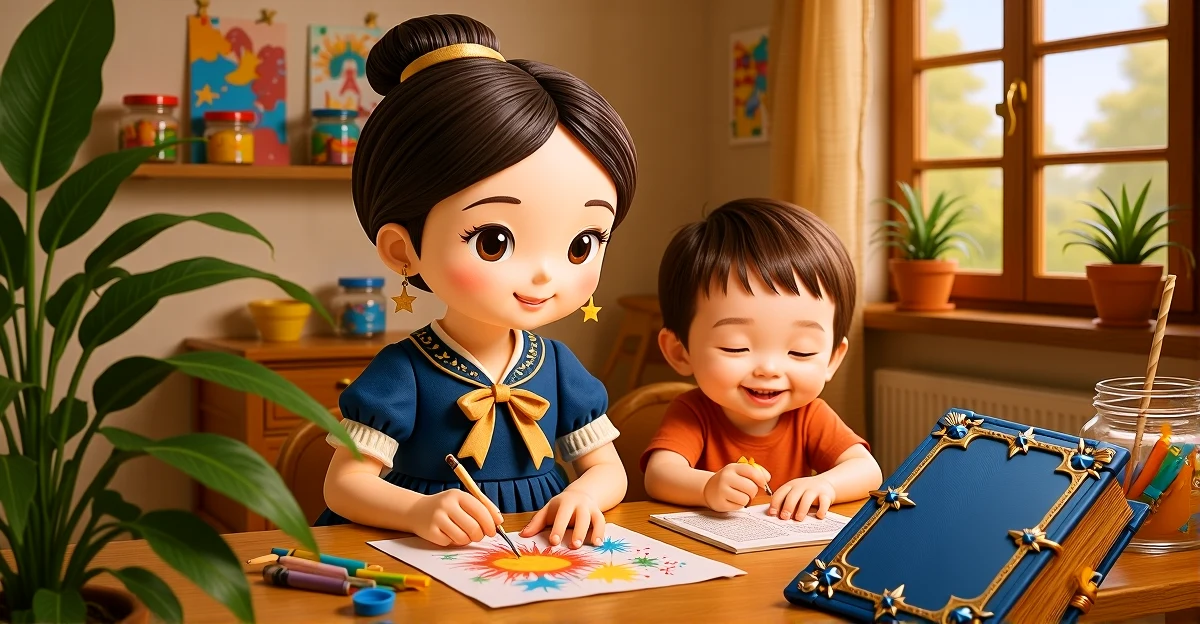
Picture this: Your five-year-old sits at the kitchen table, surrounded by paper scraps, glue bottles, markers, and finger paint. They are creating something, their face lit with concentration and pure joy. They glue seventeen pieces of tissue paper on top of each other, mix all the paint colors into brown mud, and when they show you their masterpiece, they immediately ask, can I make another one?
If you have ever wondered whether you should guide them toward something more structured, or worried about the mess, or questioned if this is really helping them learn, I want you to know something beautiful. You are witnessing one of the most important developmental processes of early childhood. And what you do next matters profoundly.
Today, the Magic Book and I are going to share what twenty years of research has taught us about artistic expression in five and six year olds. You will discover why this age is a critical window for creative development, the difference between process art and product art, and exactly how to support your child creative spirit at home.
Why Ages 5-6 Are a Critical Window for Creative Development
Here is something that might surprise you. Ages five and six represent one of the most pivotal windows for artistic development in your child entire life. This is not just me saying this. This is what decades of research has shown us.
Dr. Maite Garaigordobil at the University of the Basque Country studied thousands of children over twenty years, and what she discovered was remarkable. When children this age engage in open-ended creative experiences, something magical happens in their brains. Their verbal creativity, their graphic creativity, their ability to think in flexible and original ways, all of these bloom like flowers after spring rain.
The research shows large effect sizes specifically for five and six year olds in areas like:
- Verbal creativity: Fluency (generating many ideas), flexibility (thinking in different categories), and originality (unique solutions)
- Graphic creativity: Elaboration (adding details), fluency (producing many drawings), and originality (unique visual expressions)
- Emotional stability: Better self-regulation and emotional control
- Self-concept: Improved confidence and self-understanding
But here is what I want you to understand, and this is SO important. The type of creative experience matters profoundly. Not all art activities support this beautiful development equally.
Process Art vs. Product Art: Understanding the Difference
Let me paint you two pictures, and I want you to notice how they feel different.
Scenario One: Process Art
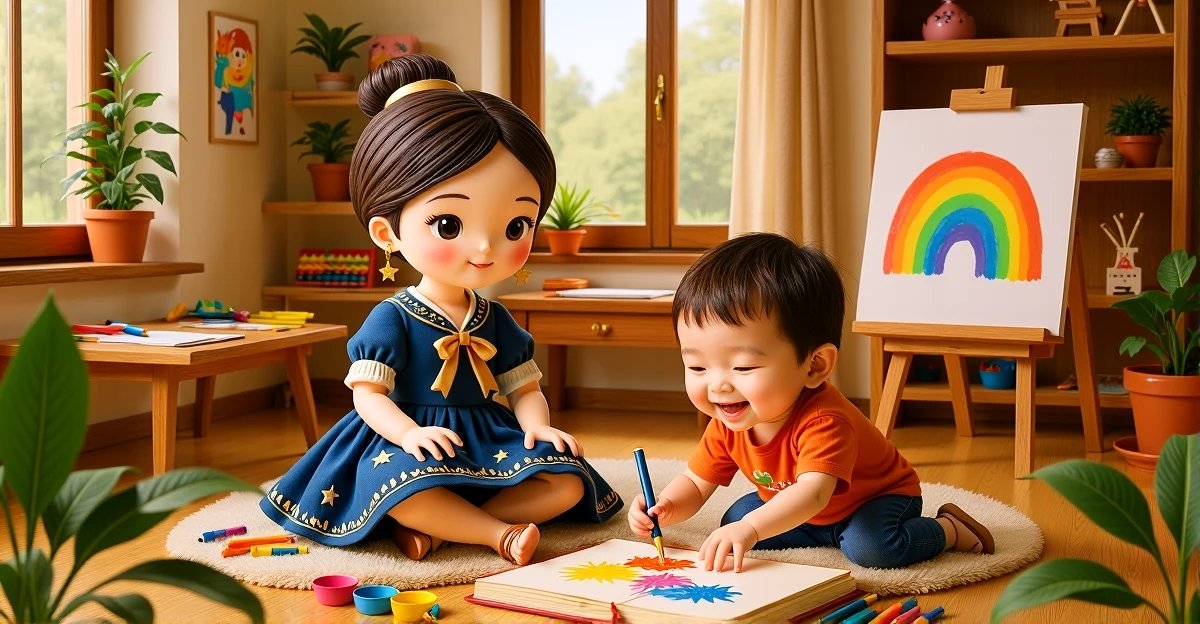
Your five year old gathers white paper, a glue bottle, scissors, bits of colored paper, tissue paper, and finger paint from their special art box. They choose which paper to cut and which to tear. They intently glue each small item to the white paper, creating a collage. Then they finger paint bright red all around their gluing, creating a framed effect. With pure delight, they show you their creation and immediately want to make another one.
Scenario Two: Product Art
Your child waits for instructions while you gather materials. You place everything on the table and say, okay, you can make this however you want, BUT the basket is the base and I cut that for you, and then the tissue paper pieces are the flowers. Let me show you how to tear the tissue paper. Your child pastes the basket in place and glues the flowers as planned. They show you what they have made and ask, is this right?
Can you feel the difference? In the first scenario, your child is exploring, thinking, expressing themselves, creating. In the second, they are following directions and seeking approval.
Dr. Laurel Bongiorno, Dean of Education at Champlain College, has studied this extensively. Her research shows that process art, where children explore materials freely without predetermined outcomes, supports physical development through fine motor skills, language development through vocabulary expansion, and social-emotional growth through self-regulation and focused attention.
Process art offers children rich opportunities for cognitive, language, and social and emotional development that product-focused art simply cannot provide. There is joy and self-exploration in self-expression.
Dr. Laurel Bongiorno, Dean of Education, Champlain College
Children engaged in exploratory art demonstrate joy, self-control, and the ability to focus. All of these are critical foundations for future school success. But product art, where children follow a sample or pattern, offers only a few learning opportunities like following directions and developing small motor control.
The Magic Book whispers this wisdom to me: When your child creates freely, without models or patterns, they are not just making art. They are building neural pathways. They are developing authentic artistic confidence. They are learning that their creative vision matters, that their ideas have value, that they can bring beauty into the world through their own unique expression.
What Children Say: The Truth About Engagement
Here is something that might ease your heart if you have ever worried about the mess or wondered if you should provide more structure.
Research shows that children doing process art say things like:
- Can I have more time?
- Can I have more paper?
- Is there any yellow?
- I want to make another one!
They are relaxed, focused, genuinely engaged. Their body language shows deep concentration and joy.
But children doing product art often say:
- Can I be done now?
- Is this right?
- Mine does not look right.
- I cannot do this.
Your child response tells you everything you need to know about which type of creative experience truly serves their development.
Gentle Strategies to Support Artistic Expression at Home
So how can you nurture your child creative spirit? The Magic Book and I have some WONDERFUL suggestions for you, all backed by research and designed to honor your child natural creativity.
1. Create a Special Art Space
Provide a bin or drawer that belongs to your child. Fill it with:
- Watercolor paints, finger paints, and brushes
- Interesting painting tools like toothbrushes, potato mashers, or sponges
- Many drawing materials: markers, crayons, colored pencils of different sizes
- Lots of blank paper rather than coloring books
- Tape, glue, and child-safe scissors
- Homemade dough or clay
When children have ownership over their materials and can access them independently, they develop agency and creative confidence.
2. Save Recycled Materials
Start a collection box for magazines, cardboard tubes, fabric scraps, buttons, bottle caps, and natural materials like pinecones or leaves. Children can use these to create collages and three-dimensional art. Every material becomes a possibility in their creative hands.
3. Try Art Outside
Paint outside for a change of setting. Use natural materials like leaves, flowers, or sticks in art projects. Let your child discover that creativity is not confined to a table indoors. The whole world becomes their canvas. This also makes cleanup easier and removes anxiety about mess.
4. Resist the Urge to Fix or Improve
This is perhaps the most important strategy of all. When your child shows you their creation, instead of saying, let me help you make the sun yellow, try saying:
- Tell me about what you made.
- What were you thinking about while you created this?
- What is your favorite part?
- How did you decide to use these colors?
This validates their creative process and builds their confidence to express themselves. It shows them that their artistic vision is sacred and valuable exactly as it is.
5. Say Yes to the Mess
When you see your five or six year old painting for the third time today, say yes. When they want to mix all the colors together and create brown mud, let them discover what happens. When they glue seventeen pieces of tissue paper on top of each other, resist the urge to suggest they spread them out. They are experimenting. They are learning. They are expressing themselves beautifully.
Dr. Garaigordobil research shows us that these creative experiences simultaneously enhance emotional stability and self-concept. When children create freely, they develop better emotional regulation. They learn to focus. They build confidence. They discover that they can bring their inner visions into the outer world.
Stories That Celebrate Creative Expression
In The Book of Inara, we have beautiful stories that bring these concepts to life for your child. Let me share one that perfectly captures the spirit of artistic expression and creative confidence.
The Canvas That Remembered Dreams
Perfect for: Ages 6-7 (also wonderful for creative 5-year-olds)
What makes it special: Theo and Miles discover an old art studio where blank canvases mysteriously show faint images of past dreams. When their community center needs a mural design, they realize that their different thinking styles, one philosophical and one strategic, combine to awaken the canvas magic. This story beautifully demonstrates how imagination creates reality and that creativity comes in many forms.
Key lesson: Your creative vision is sacred and powerful. Collaborative creation enhances individual creativity. Different thinking styles are all valuable in the creative process.
Perfect conversation starter: After reading this story with your child, ask them: What would you paint if you had a magical canvas? What dreams would you want to remember? This kind of conversation validates their artistic vision and builds creative confidence. It shows them that their ideas matter, that their imagination is sacred and powerful.
You Are Doing Beautifully
The Magic Book reminds me that every child is born with creative potential. Your role is not to teach them how to be creative. It is to provide the materials, the time, the freedom, and the encouragement for their natural creativity to flourish.
You are doing something WONDERFUL by asking how to support your child artistic expression. You are recognizing that creativity is not a luxury, it is a fundamental part of human development. You are honoring your child need to explore, to experiment, to express themselves through color and shape and texture.
Keep providing those materials. Keep saying yes to messy art projects. Keep asking your child to tell you about their creations instead of telling them how to improve them. Keep celebrating their unique artistic voice.
You are nurturing something precious. You are helping your child develop not just artistic skills, but confidence, emotional regulation, problem-solving abilities, and the intrinsic motivation to express themselves beautifully.
And that, my wonderful friend, is pure magic.
With love and starlight,
Inara
Related Articles
- When Your Child Says They're Not Creative: Understanding Ages 6-7
- Understanding Creative Confidence in Young Children (Ages 5-6)
- Why Your Child's Creative Expression Matters More Than You Think
- Why Your Child's Creative Expression Matters More Than You Think
- How to Raise a Creative Problem-Solver: Ages 5-6
Show transcript
Hello, wonderful parent! It's me, Inara, and I am SO happy you're here today. You know, the Magic Book and I have been noticing something absolutely beautiful. More and more parents are asking, how can I help my child express themselves beautifully through art? And I want you to know, this question alone shows how deeply you care about nurturing your child's creative spirit.
Today, we're going to talk about something that fills my heart with starlight. We're going to explore the magical world of artistic expression in five and six year olds, and I'm going to share what the Magic Book and the wisest researchers in child development have taught me about this WONDERFUL stage of creativity.
First, let me tell you something that might surprise you. Ages five and six represent one of the most pivotal windows for artistic development in your child's entire life. This isn't just me saying this, this is what twenty years of research has shown us. Dr. Maite Garaigordobil at the University of the Basque Country studied thousands of children, and what she discovered was remarkable. When children this age engage in open-ended creative experiences, something magical happens in their brains. Their verbal creativity, their graphic creativity, their ability to think in flexible and original ways, all of these bloom like flowers after spring rain.
But here's what I want you to understand, and this is SO important. The type of creative experience matters profoundly. There's a difference between what experts call process art and product art, and understanding this difference will transform how you support your child's creativity.
Let me paint you a picture. Imagine your five year old sitting at the kitchen table. They've gathered white paper, a glue bottle, scissors, bits of colored paper, tissue paper, and finger paint from their special art box. They choose which paper to cut and which to tear. They intently glue each small item to the white paper, creating a collage. Then they finger paint bright red all around their gluing, creating a framed effect. With pure delight, they show you their creation and immediately want to make another one.
This, my friend, is process art. And it's where the real magic happens.
Now imagine a different scenario. Your child waits for instructions while you gather materials. You place everything on the table and say, okay, you can make this however you want, BUT the basket is the base and I cut that for you, and then the tissue paper pieces are the flowers. Let me show you how to tear the tissue paper. Your child pastes the basket in place and glues the flowers as planned. They show you what they've made and ask, is this right?
Can you feel the difference? In the first scenario, your child is exploring, thinking, expressing themselves, creating. In the second, they're following directions and seeking approval.
Dr. Laurel Bongiorno, who is the Dean of Education at Champlain College, has studied this extensively. And here's what she discovered. Process art, where children explore materials freely without predetermined outcomes, supports physical development through fine motor skills, language development through vocabulary expansion, and social-emotional growth through self-regulation and focused attention. Children engaged in exploratory art demonstrate joy, self-control, and the ability to focus. All of these are critical foundations for future school success.
But product art, where children follow a sample or pattern, offers only a few learning opportunities. Following directions, yes. Developing small motor control, yes. But it doesn't offer the rich opportunities for cognitive, language, and social-emotional development that open-ended art experiences provide.
The Magic Book whispers this wisdom to me. When your child creates freely, without models or patterns, they're not just making art. They're building neural pathways. They're developing authentic artistic confidence. They're learning that their creative vision matters, that their ideas have value, that they can bring beauty into the world through their own unique expression.
And here's something that might ease your heart if you've ever worried about the mess. The research shows that children doing process art say things like, can I have more time? Can I have more paper? Is there any yellow? I want to make another one. They're relaxed, focused, genuinely engaged. But children doing product art often say, can I be done now? Is this right? Mine doesn't look right. I can't do this.
Your child's response tells you everything you need to know about which type of creative experience truly serves their development.
So how can you support your child's artistic expression at home? The Magic Book and I have some WONDERFUL suggestions for you.
First, provide a special place for art materials. Maybe it's a bin or a drawer that belongs to your child. Fill it with watercolor paints, finger paints, brushes, and interesting painting tools like toothbrushes or potato mashers. Include many drawing materials, markers, crayons, colored pencils of different sizes. Have lots of blank paper rather than coloring books. Include tape, glue, and scissors. Make homemade dough and offer clay.
Second, save recycled materials. Magazines, cardboard tubes, fabric scraps, buttons. Children can use these to create collages and three-dimensional art. Every material becomes a possibility in their creative hands.
Third, and this is SO important, try art outside. Use natural materials like leaves in art projects. Paint outside for a change of setting. Let your child discover that creativity isn't confined to a table indoors. The whole world becomes their canvas.
And fourth, resist the urge to fix or improve their art. When your child shows you their creation, instead of saying, let me help you make the sun yellow, try saying, tell me about what you made. What were you thinking about while you created this? This validates their creative process and builds their confidence to express themselves.
Now, I want to tell you about a story that beautifully captures this spirit of creative expression. It's called The Canvas That Remembered Dreams, and it's about two friends named Theo and Miles who discover an old art studio where blank canvases mysteriously show faint images of past dreams.
When their community center needs a mural design, Theo and Miles realize that their different thinking styles, one philosophical and one strategic, combine to awaken the canvas magic. The story teaches children that imagination creates reality, that creativity comes in many forms, and that collaborative creation is powerful.
After you read this story with your child, you might ask them, what would you paint if you had a magical canvas? What dreams would you want to remember? This kind of conversation validates their artistic vision and builds creative confidence. It shows them that their ideas matter, that their imagination is sacred and powerful.
The Magic Book reminds me that every child is born with creative potential. Your role isn't to teach them how to be creative. It's to provide the materials, the time, the freedom, and the encouragement for their natural creativity to flourish.
When you see your five or six year old painting for the third time today, say yes. When they want to mix all the colors together and create brown mud, let them discover what happens. When they glue seventeen pieces of tissue paper on top of each other, resist the urge to suggest they spread them out. They're experimenting. They're learning. They're expressing themselves beautifully.
Dr. Garaigordobil's research shows us that these creative experiences simultaneously enhance emotional stability and self-concept. When children create freely, they develop better emotional regulation. They learn to focus. They build confidence. They discover that they can bring their inner visions into the outer world.
And isn't that what we all want for our children? To know that their ideas matter, that their unique way of seeing the world is valuable, that they have the power to create beauty?
You're doing something WONDERFUL by asking how to support your child's artistic expression. You're recognizing that creativity isn't a luxury, it's a fundamental part of human development. You're honoring your child's need to explore, to experiment, to express themselves through color and shape and texture.
The Magic Book and I are here to support you on this journey. In The Book of Inara, you'll find stories that celebrate creativity, imagination, and the power of artistic expression. Stories that show children that their creative visions are sacred, that collaboration enhances creativity, and that art is a beautiful way to share what's in your heart.
So keep providing those materials. Keep saying yes to messy art projects. Keep asking your child to tell you about their creations instead of telling them how to improve them. Keep celebrating their unique artistic voice.
You're nurturing something precious. You're helping your child develop not just artistic skills, but confidence, emotional regulation, problem-solving abilities, and the intrinsic motivation to express themselves beautifully.
And that, my wonderful friend, is pure magic.
Sweet dreams and creative adventures! With love and starlight, Inara.