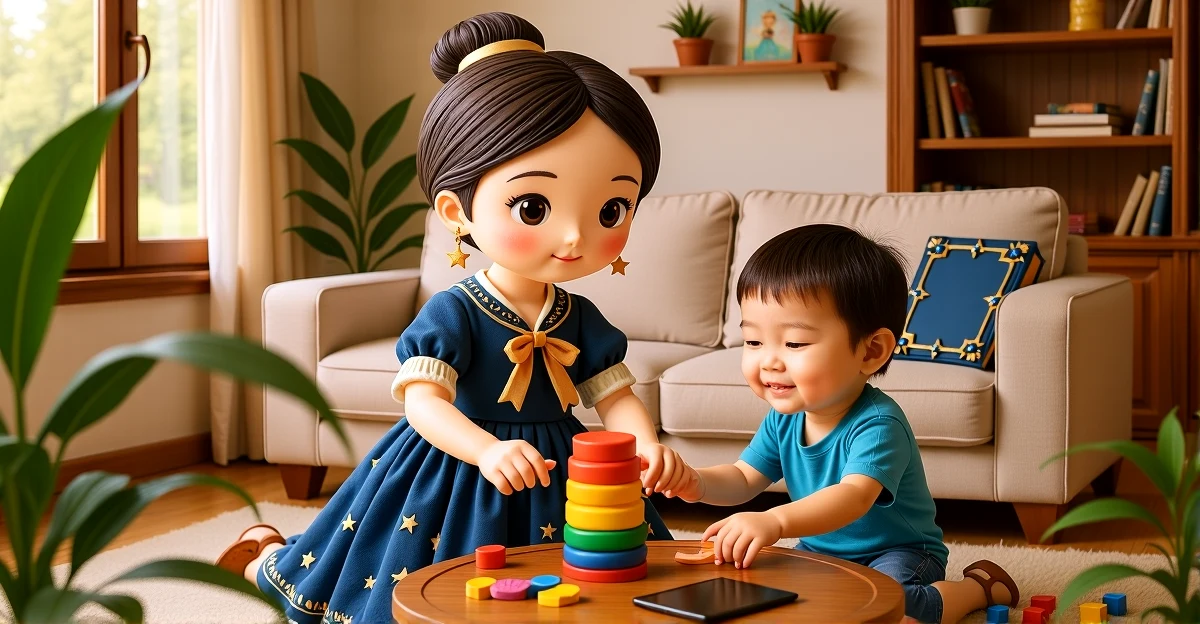

Your six or seven-year-old asks for the tablet the moment they wake up. When you say no, the meltdown begins. You watch other children playing outside while yours seems drawn to screens like a moth to starlight. And you wonder: Is this normal? Am I doing something wrong? How do I teach them about healthy technology use when they seem obsessed with screens?
\n\nIf this sounds familiar, I want you to know something important: you are not alone. This is one of the most common challenges parents face in our modern world. And there is so much we can do to help.
\n\nIn this article, I'll share what research reveals about why children gravitate toward screens, why ages 6-7 are actually the PERFECT time to teach digital citizenship, and gentle, research-backed strategies that really work.
\nWhy Your Child Gravitates Toward Screens (It's Not What You Think)
\n\nFirst, let me share something that might change your perspective entirely: when your child gravitates toward screens, they're not being difficult, lazy, or defiant. They're actually responding to something very real.
\n\nDigital content is designed to be engaging, colorful, and rewarding. It lights up their brain in ways that feel wonderful to them. And at ages six and seven, their developing brain is still learning about self-regulation - about making choices, about balancing what feels good right now with what's good for them overall.
\n\nThis isn't a character flaw. It's a developmental stage. And it's actually a beautiful learning opportunity.
\nThe Critical Developmental Window: Why Ages 6-7 Are Perfect for Teaching Digital Citizenship
\n\nHere's the hopeful news: your child is at the PERFECT age to start understanding digital citizenship and healthy technology balance.
\n\nResearch from Common Sense Education demonstrates that when children engage with age-appropriate digital citizenship education, they develop essential skills for navigating online spaces safely and responsibly. Structured lessons on media balance and online safety help children at this age build self-regulation around technology use.
\n\nYour child's brain at ages six and seven is in a critical developmental window. They're ready to understand concepts like:
\n\n- \n
- Digital footprints and online privacy \n
- Online kindness and how digital actions affect real people \n
- The importance of balancing screen time with physical activity \n
- Face-to-face social interaction and its value \n
- Using technology as a tool, not letting it use them \n
This isn't about making technology the enemy. It's about teaching your child to be the boss of their technology, not the other way around.
\nWhat Research Tells Us About Screen Time
\n\nThe Canadian Paediatric Society has studied screen time extensively, and their findings are illuminating:
\n\n- \n
- Children learn best from live, face-to-face interactions rather than screens \n
- Excessive screen time (more than 2 hours/day) is associated with self-regulation difficulties \n
- Screen time before bedtime disrupts sleep patterns due to melatonin suppression \n
- Quality educational programming with co-viewing can support learning when used appropriately \n
The Australian Institute of Family Studies adds another crucial insight: parent modeling of healthy screen habits is crucial for children's technology balance. Your child watches everything you do. When they see you putting your phone down to be present with them, when they see you choosing a walk outside over scrolling, they're learning what balance looks like.
\nFive Gentle, Research-Backed Strategies That Work
\n\n1. Model Healthy Screen Habits Yourself
\n\nThis is the foundation of everything else. You are your child's first and most important teacher in this.
\n\nPractical steps:
\n- \n
- Put your phone away during mealtimes and family time \n
- Announce when you're choosing an offline activity: "I'm going to read a book instead of checking my phone" \n
- Let your child see you enjoying screen-free activities \n
- Talk about your own technology boundaries: "I don't check work emails after dinner because family time is important" \n
This isn't about perfection. It's about awareness and small, consistent changes.
\n\n2. Create Screen-Free Zones and Times
\n\nResearch shows that boundaries around screen time help children develop self-regulation. But here's the key: frame these as gifts, not punishments.
\n\nEffective screen-free zones:
\n- \n
- Mealtimes: Make this sacred time for face-to-face connection \n
- Bedrooms: Keep screens out to protect sleep quality \n
- First hour after school: Time for decompression and connection \n
- Outdoor play time: Phones stay inside during park visits \n
When you explain these boundaries, focus on what they CREATE rather than what they restrict: "Dinner time is when we connect and share our day" rather than "No screens at dinner."
\n\n3. Co-View and Actively Engage During Screen Time
\n\nWhen your child does use screens, transform passive consumption into active learning through co-viewing.
\n\nHow to co-view effectively:
\n- \n
- Sit beside your child and watch together \n
- Ask questions about what they're seeing: "Why do you think that character did that?" \n
- Connect digital content to real life: "That's like when we saw the ocean last summer!" \n
- Discuss values and choices: "How do you think that made the other character feel?" \n
This active engagement gives you a window into their digital world and helps you guide them toward appropriate content.
\n\n4. Help Your Child Discover Joy in Diverse Activities
\n\nThis is where I want to tell you about a story that beautifully demonstrates this concept.
\n\nIn The Book of Inara, we have a tale called Pollyanna and the Glad Game. Pollyanna teaches everyone around her to find things to be glad about in all different kinds of experiences. She shows us that happiness and joy come from appreciating many different activities, not just fixating on one thing.
\n\nAfter you enjoy this story together, you can create your own Glad Game around technology balance:
\n\n- \n
- What do they love about playing outside? (Fresh air, running fast, finding bugs) \n
- What makes reading a book special? (Imagining the story, cozy reading time) \n
- What feels good about creating art? (Making something with their hands, choosing colors) \n
- What's fun about screen time? (Learning new things, playing games) \n
When children learn to appreciate diverse experiences, they naturally find balance. They discover that joy comes from many sources, not just one.
\n\n5. Teach Digital Citizenship in Age-Appropriate Ways
\n\nYour 6-7 year old is ready to learn about being a good digital citizen. Make these conversations natural and ongoing:
\n\nOnline Kindness: Talk about how the things we say and do online affect real people with real feelings. "If you wouldn't say it to someone's face, don't type it."
\n\nPrivacy: Teach about keeping personal information safe. "We don't share our address, phone number, or school name online."
\n\nCritical Thinking: Help them question what they see. "Is that real or pretend? How can we tell?"
\n\nPositive Use: Show them how technology can be used to learn, create, and connect in positive ways.
\nWhen Screen Time Becomes a Battle: What to Do
\n\nEven with the best strategies, you'll face resistance. Here's how to handle it:
\n\nGive Warnings: "Screen time ends in 5 minutes. What would you like to do after?"
\n\nOffer Choices: "Would you like to play outside or do an art project after screen time?"
\n\nValidate Feelings: "I know you're disappointed screen time is over. It's hard to stop doing something fun."
\n\nStay Consistent: Follow through with boundaries calmly and consistently.
\n\nRedirect to Connection: "Let's go build that fort you wanted to make!"
\nA Story That Teaches This Beautifully
\n\nPollyanna and the Glad Game
\nPerfect for: Ages 6-7
\nWhat makes it special: This story shows children how to find joy and things to be glad about in ALL different kinds of experiences, not just one favorite thing. Pollyanna's Glad Game teaches appreciation for diverse activities and helps children understand that happiness comes from many sources.
\nKey lesson: Balance and joy come from appreciating many different experiences. When we learn to find things to love about various activities - both screen time AND outdoor play, reading, art, and family time - we discover that life is richer and more fulfilling.
\nParent talking point: After reading this story together, create your own family Glad Game. Each day, find things to be glad about in both screen time and screen-free activities. This positive approach helps children develop appreciation for diverse experiences naturally.
\nThe Long-Term Impact of Teaching Digital Citizenship Now
\n\nWhen you teach your child healthy technology balance and digital citizenship at ages 6-7, you're giving them skills they'll use for their entire life:
\n\n- \n
- Self-regulation and the ability to make healthy choices \n
- Understanding that technology is a tool to be used wisely \n
- Appreciation for diverse activities and experiences \n
- Online safety and privacy awareness \n
- Kindness and empathy in digital spaces \n
- Critical thinking about digital content \n
This work you're doing now - every loving boundary you set, every time you model healthy habits, every time you help your child discover joy in diverse activities - is laying the foundation for a lifetime of healthy technology use.
\n\nYour child isn't obsessed with screens because something is wrong with them or because you've failed as a parent. They're learning, they're exploring, they're discovering. And with your gentle guidance, they can learn to use technology as a tool for good while still honoring their need for physical play, face-to-face connection, and imaginative adventures.
\n\nYou are doing such important work. This isn't about perfection. It's about progress, about connection, about raising a child who can navigate our digital world with wisdom and kindness.
\n\nWith stardust and unwavering belief in your parenting journey,
Inara ✨
Related Articles
- How to Nurture Your Child's Empathy and World-Changing Impact (Ages 6-7)
- Understanding Screen Time Balance: Gentle Strategies for Ages 5-6
- Nurturing Your Child Innovation Mindset: A Gentle Guide for Ages 6-7
- When Your Child Makes Insensitive Comments: A Gentle Guide to Teaching Cultural Awareness
- Nurturing Purpose and Meaning in Young Children: A Gentle Guide for Parents
Show transcript
Hello, wonderful parent! It's me, Inara, and I am SO glad you're here today. You know, the Magic Book and I have been noticing something that so many families are experiencing right now. Your child seems drawn to screens like a moth to starlight, and you're wondering how to help them find balance and understand what it means to be a good digital citizen. And I want you to know something really important, you are not alone in this. This is one of the most common challenges parents face in our modern world, and there is so much we can do to help!
So settle in, take a deep breath, and let's talk about what's really happening when your six or seven year old seems to only want screen time, and more importantly, how we can guide them toward healthy technology balance with love and understanding.
First, let me share something the Magic Book taught me that changed everything. When your child gravitates toward screens, they're not being difficult or lazy. They're actually responding to something very real. Digital content is designed to be engaging, colorful, and rewarding. It lights up their brain in ways that feel WONDERFUL to them. And at ages six and seven, their developing brain is still learning about self-regulation, about making choices, about balancing what feels good right now with what's good for them overall.
This is actually a beautiful learning opportunity. Your child is at the perfect age to start understanding digital citizenship, to learn that technology is a tool we use wisely, not something that uses us.
Now, let me share what the research tells us. The Canadian Paediatric Society has studied this carefully, and they've found that children learn best from live, face to face interactions rather than screens. But here's the hopeful part, when children engage with age appropriate digital citizenship education, they develop essential skills for navigating online spaces safely and responsibly. Common Sense Education has shown that structured lessons on media balance and online safety help children build self regulation around technology use.
And here's something really important. Your child's brain at ages six and seven is in a critical developmental window. They're ready to understand concepts like digital footprints, online kindness, and the importance of balancing screen time with physical activity and face to face social interaction. This isn't about making technology the enemy. It's about teaching your child to be the boss of their technology, not the other way around.
So what can you do? Let me share some gentle, research backed strategies that really work.
First, model healthy screen habits yourself. Your child watches everything you do. When they see you putting your phone down to be present with them, when they see you choosing a walk outside over scrolling, they're learning what balance looks like. The Australian Institute of Family Studies found that parent modeling of healthy screen habits is crucial for children's technology balance. You are their first and most important teacher in this.
Second, create screen free zones and times in your home. Make mealtimes sacred, a time when everyone connects face to face. Make bedrooms screen free zones, because research shows that screen time before bedtime disrupts sleep patterns. These boundaries aren't punishments, they're gifts. They're creating space for connection, for imagination, for the kind of play that builds their growing brain.
Third, when your child does use screens, co view with them. Sit beside them, ask questions about what they're watching or playing, connect the digital content to real life. This active engagement transforms passive screen time into a learning opportunity. It also gives you a window into their digital world, so you can guide them toward appropriate content and help them understand what they're seeing.
Fourth, help your child discover the joy of diverse activities. This is where I want to tell you about a story that might help. In The Book of Inara, we have a beautiful tale called Pollyanna and the Glad Game. Pollyanna teaches everyone around her to find things to be glad about in all different kinds of experiences. She shows us that happiness and joy come from appreciating many different activities, not just fixating on one thing.
After you enjoy this story together, you can create your own Glad Game around technology balance. Help your child find things to be glad about in both screen time AND screen free activities. What do they love about playing outside? What makes reading a book special? What feels good about creating art or building with blocks? When children learn to appreciate diverse experiences, they naturally find balance.
And finally, teach your child about digital citizenship in age appropriate ways. Talk about online kindness, about how the things we say and do online affect real people with real feelings. Talk about privacy, about keeping personal information safe. Talk about being a good digital citizen, someone who uses technology to learn, create, and connect in positive ways.
The Magic Book whispers this truth to me. Your child isn't obsessed with screens because something is wrong with them. They're learning, they're exploring, they're discovering. And with your gentle guidance, they can learn to use technology as a tool for good while still honoring their need for physical play, face to face connection, and the kind of imaginative adventures that happen away from screens.
You are doing such important work, my friend. Every time you set a loving boundary, every time you model healthy habits, every time you help your child discover joy in diverse activities, you're teaching them skills they'll use for their entire life. This isn't about perfection. It's about progress, about connection, about raising a child who can navigate our digital world with wisdom and kindness.
The Book of Inara is here to help you on this journey. We have stories that teach self regulation, stories that celebrate diverse interests, stories that show children the magic that exists both on screens and in the world around them.
Sweet dreams and bright mornings, my wonderful friend. You've got this. With love and starlight, Inara.